Natural History
Annularia gracilescens — Permian Fossil Leaf Whorls
Permian Period, ca. 299–252 Million Years, China
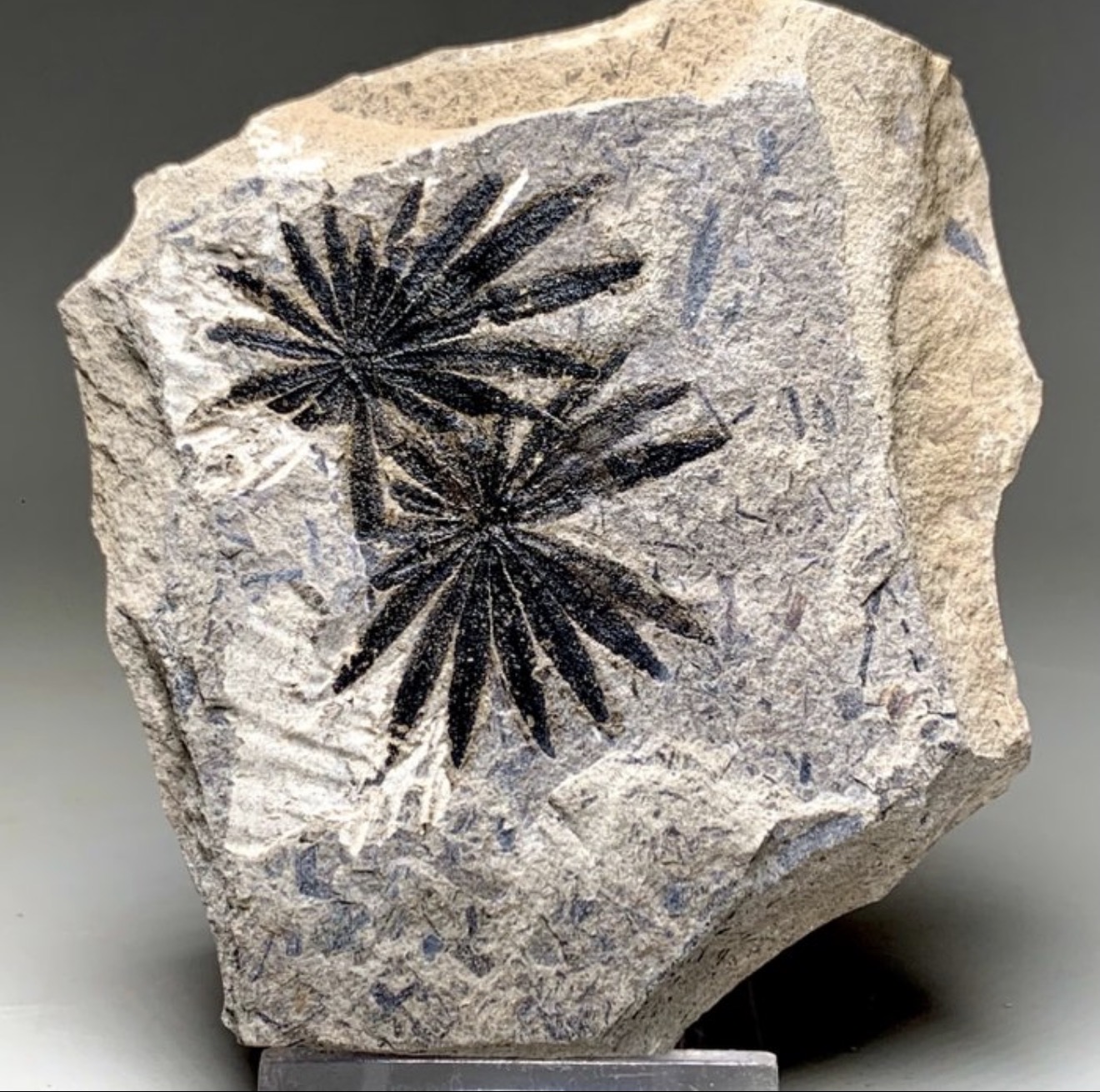
A rare and beautifully preserved plate bearing two complete leaf whorls of Annularia gracilescens — the foliage of the extinct arborescent horsetail Calamites — from the Permian of China. These delicate stellate impressions, dating to approximately 270 million years ago, offer a direct window into the coal-swamp forests that dominated the equatorial regions of Cathaysia during the late Palaeozoic era.
Annularia is a form taxon applied to the distinctive whorled leaves of Calamites, giant relatives of modern horsetails (Equisetum) that grew as trees reaching heights of up to 20 metres in the warm, humid swamp forests of the Carboniferous and Permian periods (Taylor, Taylor & Krings, 2009). The present specimen displays two exceptionally well-defined whorls, each comprising approximately 16–20 narrow, lanceolate leaflets radiating symmetrically from a central node — the characteristic arrangement that gives these fossils their unmistakable star-like appearance.
The preservation is outstanding: the leaflets retain their original proportions and spatial arrangement, compressed into a deep black carbonaceous film against the pale grey siltstone matrix. The fine venation and pointed leaf tips are clearly discernible, indicating rapid burial in a low-energy depositional environment that prevented decay and disarticulation. The species A. gracilescens is distinguished from the more common A. stellata by its more slender, elongated leaflets and slightly fewer leaves per whorl (Boureau, 1964).
Permian floras of China — particularly those of the North China Block — represent a critical record of terrestrial ecosystem evolution during the transition from the ice-age conditions of the Carboniferous to the hothouse world of the Mesozoic (Wang et al., 2012). Sphenopsid plants like Calamites/Annularia were among the last survivors of the great coal-swamp ecosystems before the devastating end-Permian mass extinction eliminated approximately 95% of all species on Earth.
Provenance & Details
Enquire