Antiquities
Apulian Red-Figure Kantharos
4th Century B.C., Magna Graecia, ex Parthenon Gallery London
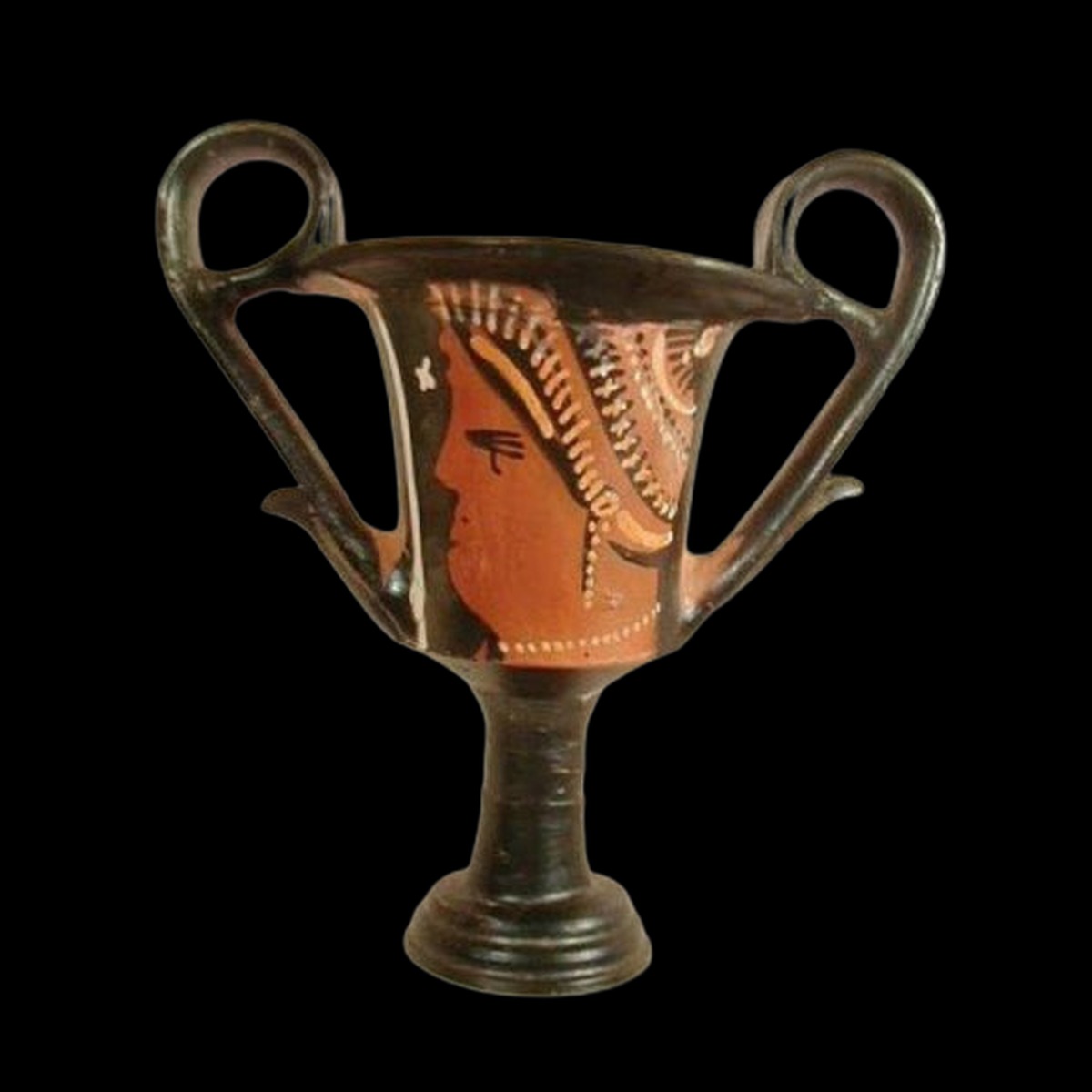
A refined example of Apulian red-figure pottery from the 4th century B.C. — a kantharos, the distinctive two-handled drinking vessel associated with Dionysus and the symposium culture of ancient Greece. This elegant cup was produced in the workshops of Magna Graecia, the Greek colonies of southern Italy, where Apulian potters developed their own sophisticated artistic tradition.
Both sides of the vessel feature the so-called "Lady of Fashion" — a female figure adorned with a radiate stephane (crown), ribbon sakkos (hair covering), necklace, and earrings. This decorative motif, characteristic of later Apulian production, reflects the refined aesthetic sensibility of the Greek colonial elite. The figures are framed by white Ionic columns, lending an architectural dignity to the composition.
The kantharos stands on a pedestal foot in four degrees, rising to a globular body with elegant concave handles that scroll down to a leaf form — a hallmark of quality craftsmanship. The vessel measures 16.8 cm in height, 15 cm across the handles, and 9 cm across the cup.
The condition is overall good, with professional restoration to the top of the rim on one side incorporating original fragments, and some paint touch-up. This level of conservation is entirely consistent with vessels of this age and enhances rather than diminishes the object's scholarly and aesthetic value.
Provenance: Ex Parthenon Gallery, London, with an earlier collection inventory mark on the base.
Provenance & Details
- •Trendall, A.D., and Cambitoglou, A., The Red-Figured Vases of Apulia, 1978-1982
- •Jentoft-Nilsen, M. R., and Trendall, A.D., Corpus Vasorum Antiquorum, USA, fasc. 27, The J. Paul Getty Museum, fasc. 3, 1990
- •Schmidt, M., Trendall, A. D., and Cambitoglou, A., Eine Gruppe apulischer Grabvasen in Basel, 1976
- •British Museum, Apulian red-figured kantharos with female head, ca. 320-310 BC (Acc. No. G_1885-0117-1)
- •The Metropolitan Museum of Art, Terracotta kantharos with two female heads, 4th century B.C.
- •J. Paul Getty Museum, Apulian Red-Figure Kantharos, about 330–320 B.C. (Object No. 103TWG)
- •Cleveland Museum of Art, Red-Figure Kantharos (Drinking Cup): Female Heads, 330–320 BCE (Acc. No. 1967.246)
THE ART OF THE SYMPOSIUM: APULIAN RED-FIGURE POTTERY
In the 4th century B.C., the Greek colonies of southern Italy — collectively known as Magna Graecia — produced some of the finest painted pottery in the ancient world. Apulia, centred on the city of Taras (modern Taranto), became the most prolific centre of red-figure pottery production outside Athens itself, developing a distinctive regional style that combined Greek artistic traditions with local Italic influences.
The kantharos — a deep, two-handled drinking cup — was intimately associated with Dionysus, the god of wine, and with the symposium, the ritualized drinking party that was central to Greek social and intellectual life. To hold a kantharos was to participate in a tradition that connected the drinker to the divine, to the pleasures of conversation and philosophy, and to the bonds of friendship that the symposium was designed to strengthen.
The "Lady of Fashion" motif that decorates this vessel is characteristic of later Apulian production, when the elaborate mythological scenes of earlier periods gave way to more decorative, elegant compositions. These fashionably dressed female figures — adorned with stephane crowns, ribbon sakkoi, necklaces, and earrings — reflect the refined tastes of the colonial Greek elite and their appreciation for beauty, luxury, and personal adornment.
The provenance of this kantharos traces back to the Parthenon Gallery in London, a respected dealership in classical antiquities. The earlier collection inventory mark on the base provides additional evidence of the vessel's documented history. Such provenance is increasingly important in the field of classical archaeology, where the documented history of an object enhances both its scholarly value and its standing in the market.
Enquire