Natural History
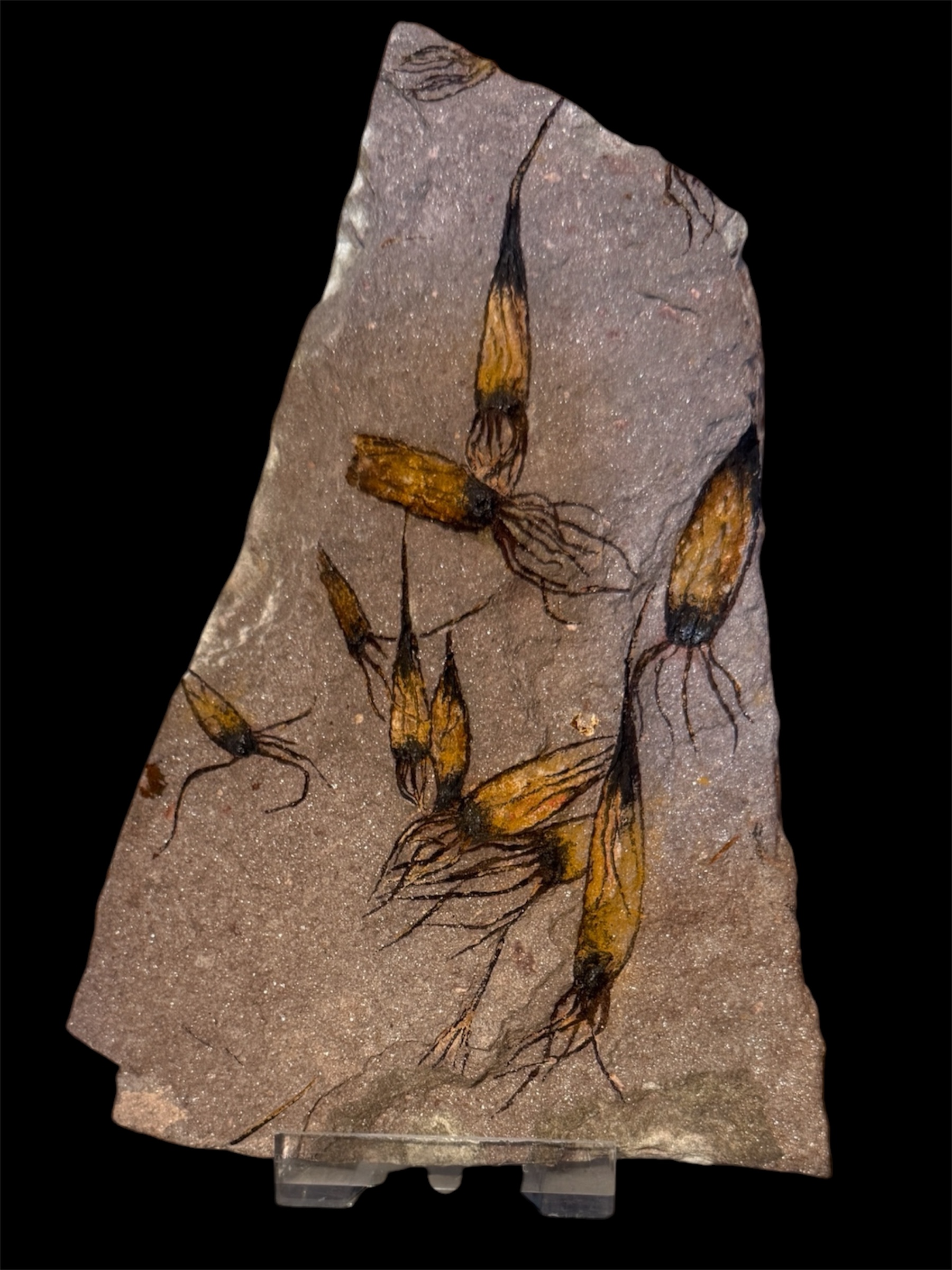
Ascocystites sp. — Ordovician Eocrinoid Museum Plate
Upper Ordovician, ca. 450 Million Years, Morocco
A spectacular museum-quality plate preserving ten articulated specimens of the eocrinoid Ascocystites — one of the earliest known groups of stalked echinoderms — from the Upper Ordovician Ktaoua Formation near El Kaid Errami in the eastern Anti-Atlas of Morocco. This extraordinary assemblage dates to approximately 450 million years ago, a period when the shallow seas of Gondwana teemed with an unprecedented diversity of echinoderm life during the Great Ordovician Biodiversification Event.
The specimens display the diagnostic morphology of Ascocystites in remarkable detail: elongate, flask-shaped thecae composed of numerous thin polygonal plates, from which radiate delicate brachioles — the filter-feeding appendages that captured suspended organic particles from the water column. The iron hydroxide (Fe(OH)₂) mineralisation imparts a striking golden-amber colouration to the thecae, while the brachioles and stems are preserved in contrasting iron oxyhydroxide (black), creating an arresting visual composition against the grey-pink siliciclastic matrix.
The largest individual on the plate measures nearly 9 cm in length — an exceptional size for this genus, whose thecae typically range between 3 and 7 cm (Parsley, 2021). The near-complete articulation of multiple specimens on a single bedding plane suggests rapid burial by a sediment gravity flow, preserving an in-situ or parautochthonous community of these suspension feeders. Such multi-specimen plates from the Ktaoua Formation represent some of the most important echinoderm Lagerstätten of the Ordovician world (Hunter et al., 2010).
The plate has been professionally enhanced with stone reviver and mineral oxide to accentuate the contrast between the fossil material and the surrounding matrix — a standard preparation technique that affects approximately 15–20% of the visual presentation without altering the underlying morphology. The specimen is 100% natural and not composite.
Provenance & Details
Enquire