Natural History
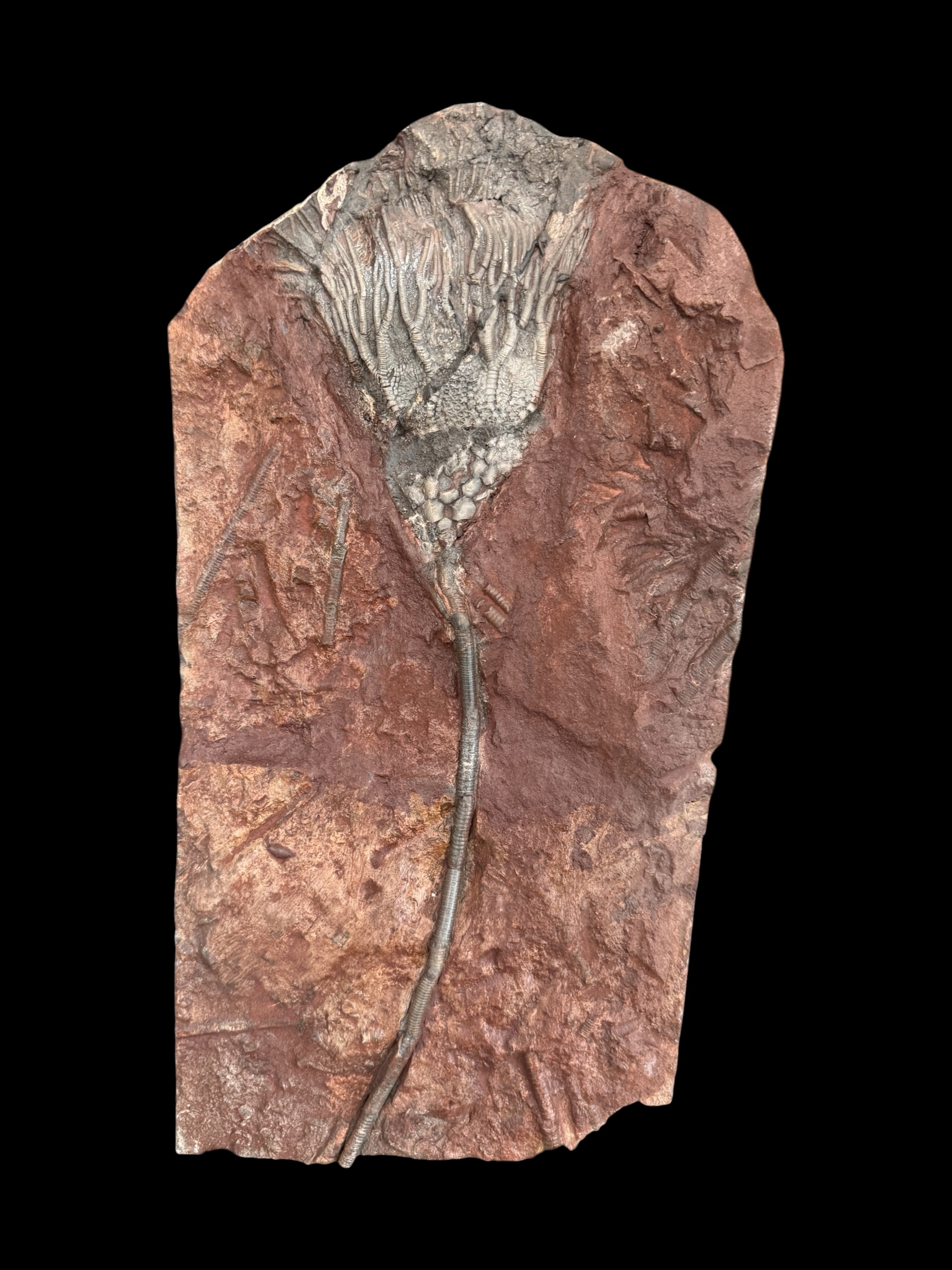
Fossil Crinoid — Complete Stalked Sea Lily
Carboniferous Period, c. 320 million years before present
A remarkably well-preserved fossil crinoid, or sea lily, displaying the complete anatomy of the organism: a finely segmented stem, a robust calyx composed of interlocking calcite plates, and an elaborate crown of branching arms (brachia) that once filtered nutrients from the warm, shallow seas of the Carboniferous period. The specimen is preserved in its original reddish-brown siltstone matrix, a sediment type characteristic of classic Carboniferous Limestone formations across Europe and North America. The three-dimensional preservation of the crown, with individual pinnules still clearly visible, is exceptional and indicates rapid burial in a low-energy environment, which prevented disarticulation — a fate that befalls the vast majority of crinoid remains.
Crinoids are among the most ancient of living animal groups, with a fossil record extending back to the Ordovician period, some 480 million years ago. Despite their plant-like appearance, they are echinoderms, related to starfish and sea urchins. During the Carboniferous, crinoids reached their greatest diversity and abundance, forming vast submarine meadows that contributed significantly to the formation of limestone beds. Complete specimens with crown, calyx, and stem preserved in articulation are rare and highly prized by collectors and institutions alike. The present example, with its imposing height of approximately 30 cm, represents a museum-quality fossil of considerable scientific and aesthetic merit.
What was the Carboniferous world like?
Three hundred and twenty million years ago, the continents were converging into the supercontinent Pangaea. Vast tropical seas covered much of what is now Europe, their floors carpeted with crinoid meadows so dense that their accumulated skeletons built entire mountain ranges of limestone. The atmosphere held 35% oxygen — enough to sustain dragonflies with 70-cm wingspans. On land, the first great forests of scale trees and tree ferns were laying down the coal seams that would fuel the Industrial Revolution.
Why are complete crinoids so rare?
A crinoid skeleton is not a single bone but hundreds of individual calcite segments held together only by soft tissue. The moment an animal dies, decay releases these segments, scattering them across the seafloor within hours. Only sudden burial — a storm deposit, a turbidity current, a collapsing bank — can entomb the animal before disarticulation. For every complete specimen that survives, millions are reduced to isolated stem segments (the familiar “St Cuthbert’s beads” of English folklore).
Provenance & Details
- •Private collection, acquired prior to 1970.
- •from the Private Collection K. N. H., Switzerland
- •Hess, H. et al., Fossil Crinoids, Cambridge University Press, 1999
- •Webster, G.D., GSA Special Paper 363, 2003
- •Ausich, W.I. & Kammer, T.W., Palaeontology, Vol. 56(4), 2013, pp. 727–740
Enquire