Antiquities
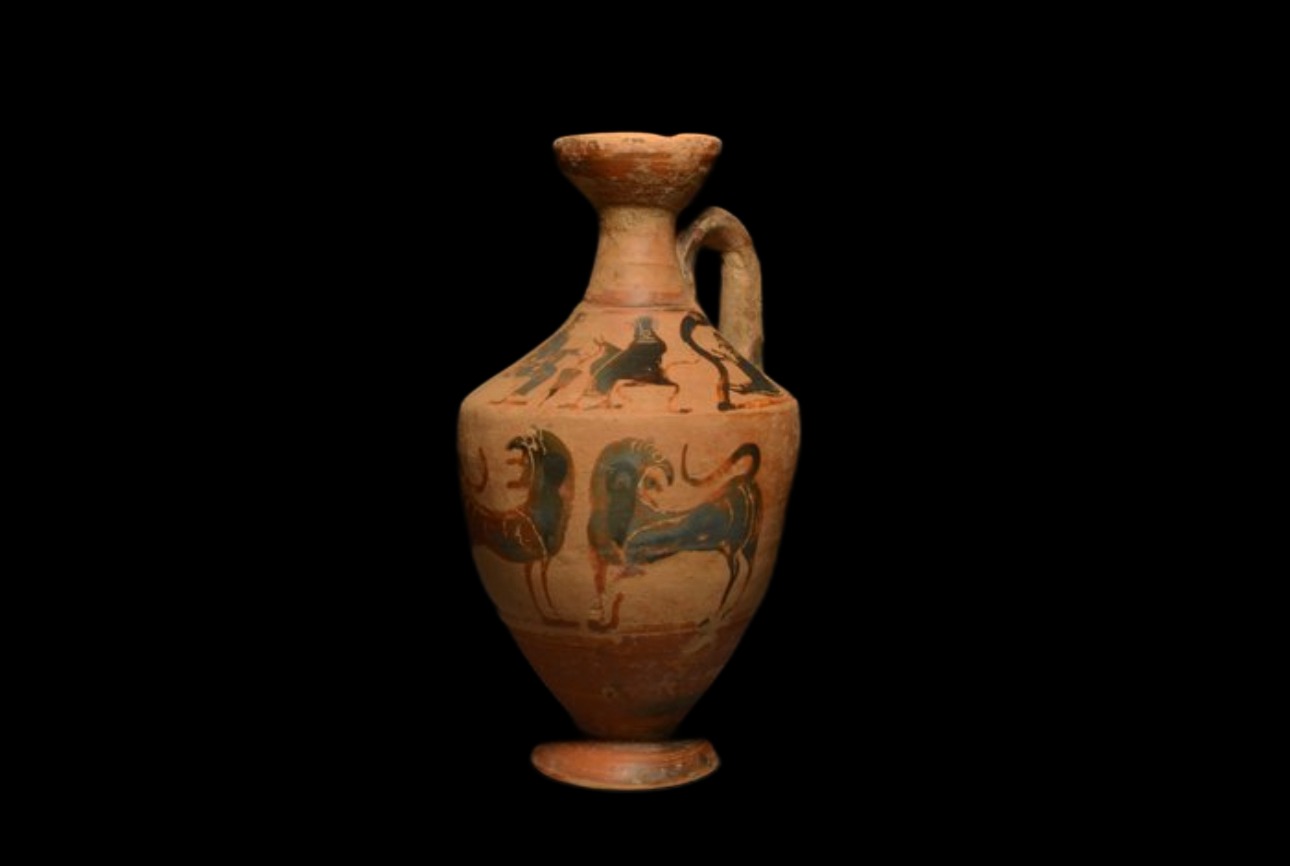
Corinthian Lekythos
Greek, 7th–6th Century BC
This elegant vessel once held precious perfumed oil — a luxury in the ancient world that was intimately connected with the most significant moments of human life. Lekythoi accompanied the living to the gymnasium and the bath, anointed the bodies of brides on their wedding day, and — most poignantly — were placed in the graves of the beloved dead as a final gift of tenderness.
Corinth, where this vessel was crafted, was one of the great centres of Greek ceramic art. Corinthian potters developed a distinctive style of miniature painting — intricate animal friezes, mythological scenes, and geometric patterns rendered with extraordinary precision on the curved surfaces of their vessels. Each lekythos was a small masterpiece of design and craftsmanship, shaped on the potter's wheel and painted with pigments derived from iron-rich clay.
The survival of this vessel across nearly three millennia is a testament to both the skill of its maker and the reverence with which it was treated. Somewhere in the ancient world, someone placed this lekythos beside a body they loved, believing that the fragrant oil within would ease the passage of the soul. That act of love has preserved this object through the rise and fall of empires, through centuries of silence in the earth, to reach us here — still beautiful, still eloquent, still speaking of the human need to honour the dead.
Provenance & Details
- •Private collection, acquired prior to 1970.
- •from the Private Collection K. N. H., Switzerland
- •Amyx, Darrell A., Corinthian Vase-Painting of the Archaic Period, University of California Press, 1988
- •Payne, Humfry, Necrocorinthia: A Study of Corinthian Art in the Archaic Period, Oxford University Press, 1931
- •Benson, J. L., Earlier Corinthian Workshops: A Study of Corinthian Geometric and Protocorinthian Stylistic Groups, Allard Pierson Museum, 1989
- •Schaus, Gerald P., A Corinthian Cylindrical Lekythos in the Paul Canellopoulos Collection, Bulletin de Correspondance Hellénique, 1975
- •Stillwell, Agnes Newhall, and J. L. Benson, The Potters' Quarter: The Pottery, American School of Classical Studies at Athens, 1984
- •British Museum, London
- •Musée du Louvre, Paris
- •National Archaeological Museum, Athens
Corinth's dominance of the Mediterranean pottery trade between the late eighth and early sixth centuries BC produced some of the most technically accomplished and aesthetically refined ceramics of the Archaic Greek world. The city's potters developed a distinctive miniaturist painting tradition — the so-called Proto-Corinthian and Ripe Corinthian styles — characterised by densely packed animal friezes, orientalising floral motifs, and mythological narratives executed with a precision that rivalled contemporary metalwork and ivory carving.¹ The lekythos, a narrow-necked oil vessel with a single vertical handle, emerged as one of the most characteristic shapes of this production, its form engineered to dispense precious perfumed oil drop by drop — a design feature that reflected the extraordinary value of its contents in the ancient economy.
The function of the lekythos extended far beyond the domestic sphere. In the gymnasium, athletes anointed their bodies with olive oil before exercise and scraped it off with a strigil afterwards; the lekythos was the indispensable vessel for this ritual of bodily care that was central to Greek civic identity.² In funerary contexts, the lekythos assumed its most solemn role. Oil was used to anoint the body of the deceased during the prothesis (laying-out), and lekythoi were placed within the grave or deposited at the tomb as offerings to the dead. The Kerameikos cemetery in Athens has yielded hundreds of such vessels in situ, many still containing traces of their original contents.³ Comparable Corinthian lekythoi of the seventh to sixth century BC are held in the collections of the British Museum (inv. 1865,1118.208), the Louvre (inv. CA 931), and the National Archaeological Museum, Athens.
Corinthian ceramic production operated on a near-industrial scale. The Potters' Quarter excavated by the American School of Classical Studies at Ancient Corinth revealed kiln complexes, mould fragments, and vast quantities of wasters that attest to a highly organised workshop system supplying markets from Sicily to the Black Sea.⁴ The orientalising repertoire of Corinthian painters — lions, sphinxes, sirens, and composite beasts drawn from Near Eastern prototypes — reflects the cosmopolitan networks of trade and cultural exchange that defined the Archaic Mediterranean. By the mid-sixth century, Athenian black-figure production had eclipsed Corinthian ware, but the legacy of Corinthian innovation in ceramic form, decorative technique, and commercial distribution remained foundational to the entire subsequent history of Greek pottery.
The present lekythos, with its characteristic Corinthian fabric and proportions, belongs to this tradition of refined craftsmanship and ritual purpose. Its survival across nearly three millennia speaks not only to the durability of its material but to the reverence with which it was treated — placed, in all likelihood, beside someone beloved, with the belief that the fragrant oil within would ease the passage of the soul.
¹ J. Boardman, Early Greek Vase Painting, Thames & Hudson, 1998, pp. 87–112. ² M. B. Poliakoff, Combat Sports in the Ancient World, Yale University Press, 1987, pp. 7–15. ³ D. C. Kurtz and J. Boardman, Greek Burial Customs, Thames & Hudson, 1971, pp. 98–105. ⁴ A. N. Stillwell and J. L. Benson, Corinth XV.3: The Potters' Quarter — The Pottery, American School of Classical Studies at Athens, 1984.
Enquire