Antiquities
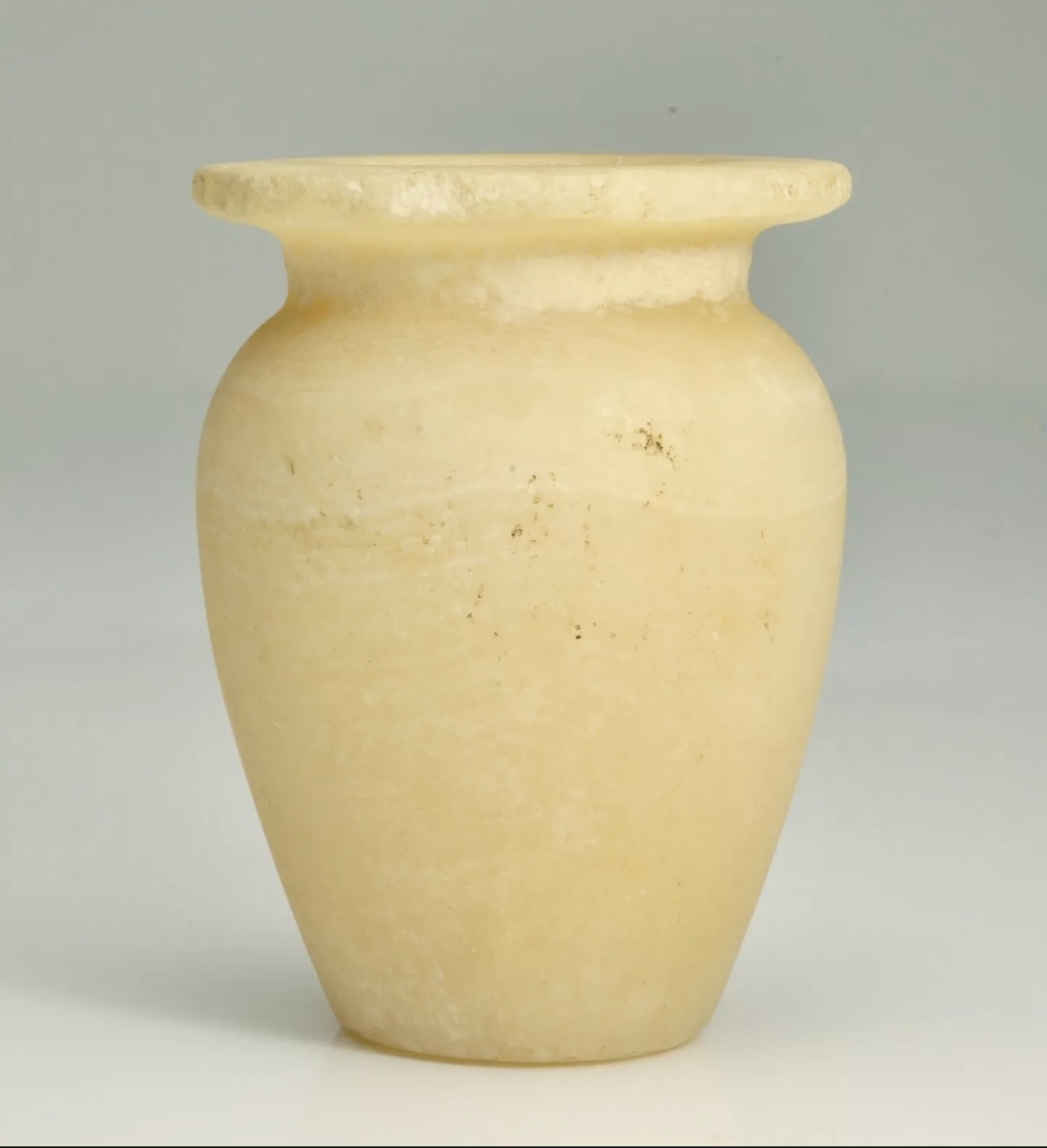
Egyptian Alabaster Cosmetic Jar
Middle Kingdom, ca. 2055–1650 B.C., ex Christie's London 2000
An Egyptian alabaster (calcite) cosmetic jar of the Middle Kingdom period, ca. 2055–1650 B.C. The vessel features a characteristic everted flat rim, a gently tapering cylindrical body, and a flat base — a form well attested in funerary and domestic contexts of the Twelfth Dynasty. Measuring 8 cm in height and 6 cm in diameter, this compact jar was designed to hold precious cosmetic substances such as kohl, unguents, or perfumed oils, which played a central role in both daily life and funerary ritual in ancient Egypt.
The alabaster — more precisely Egyptian calcite or travertine — displays a warm, translucent quality with subtle banding typical of quarries in the Hatnub region of Middle Egypt, the principal source of this prized material throughout pharaonic history. The surface retains an attractive age-related patina that testifies to the vessel's antiquity. The condition is very good overall, with only minor ancient losses to the lip rim and three fine hairlines related to the original manufacture — evidence of the stone's natural crystalline structure rather than later damage.
The jar was formerly in a German private collection assembled in the 1950s and subsequently appeared at Christie's London antiquities sale on 12 April 2000 as part of Lot 15.
Provenance & Details
- •Ex 1950s German private collection
- •Ex Christie's London, 12 April 2000, Lot 15 (part)
- •from the Private Collection K. N. H., Switzerland
- •B.G. Aston, Ancient Egyptian Stone Vessels: Materials and Forms, Heidelberg, 1994
- •W.M.F. Petrie, Stone and Metal Vases, London, 1937
- •C. Lilyquist, Egyptian Stone Vessels, Metropolitan Museum of Art, New York, 1995
- •J. Bourriau, Pharaohs and Mortals: Egyptian Art in the Middle Kingdom, Cambridge, 1988
- •Metropolitan Museum of Art, New York (acc. 26.7.1442 — travertine cosmetic jar, Dynasty 12, ca. 1805 B.C., from Thebes)
- •Metropolitan Museum of Art, New York (acc. 15.3.341 — travertine cosmetic jar, Dynasty 12, ca. 1981–1900 B.C., from Lisht North)
- •British Museum, London (EA32667 — calcite vessel, Middle Kingdom)
- •Christie's London (Lot 5060862 — two stone cosmetic jars, Dynasty XII, ex coll. Gaston Maspero)
- •Bonhams (Egyptian alabaster double cosmetic jar, 12th Dynasty, ca. 1976–1793 B.C.)
The production of stone vessels in ancient Egypt represents one of the longest continuous craft traditions in human history, extending from the Predynastic period through the Roman era — a span of more than three thousand years. Among the materials employed, none was more closely associated with Egyptian civilisation than calcite, commonly known as Egyptian alabaster or travertine. This translucent, warmly banded stone was quarried principally at Hatnub in Middle Egypt, a site whose inscriptions record royal expeditions dispatched to obtain this prized material from as early as the Old Kingdom. ¹ The present cosmetic jar, carved from this characteristic calcite with its subtle veining and luminous surface, belongs to a well-established typological group of the Middle Kingdom period (ca. 2055–1650 B.C.).
The vessel's form — a gently tapering cylindrical body rising from a flat base to a broad, everted flat rim — is one of the most widely attested shapes in the Middle Kingdom stone vessel repertoire. Barbara G. Aston's comprehensive study of ancient Egyptian stone vessels classifies this type among the standard cosmetic containers of the Twelfth Dynasty, noting their prevalence in both funerary assemblages and domestic contexts. ² Such jars were designed to hold precious substances including kohl (eye paint), perfumed unguents, and aromatic oils — materials that played a central role in Egyptian daily life, religious ritual, and funerary practice. The compact dimensions of the present example (H. 8 cm; Diam. 6 cm) are consistent with personal toilet vessels intended for individual use.
Closely comparable examples are held in major museum collections. The Metropolitan Museum of Art, New York, preserves a travertine cosmetic jar of Dynasty 12 (acc. 26.7.1442, ca. 1805 B.C.) excavated by Lord Carnarvon and Howard Carter at Thebes in 1910, found together with a cosmetic box belonging to the Royal Butler Kemeni. ³ A second Metropolitan Museum example (acc. 15.3.341, ca. 1981–1900 B.C.), excavated at Lisht North from the Tomb of Antefiker, demonstrates the same characteristic form in an early Twelfth Dynasty context. The British Museum holds a calcite vessel of comparable type (EA32667), while Christie's London has offered closely related pairs of stone cosmetic jars attributed to Dynasty XII, including a notable pair formerly in the collection of the distinguished Egyptologist Gaston Maspero (1846–1916). ⁴
The condition of the present jar is very good overall, displaying the warm, age-related patina that distinguishes genuinely ancient calcite vessels from modern reproductions. Minor ancient losses to the lip rim and three fine hairlines are attributable to the natural crystalline structure of the stone and the stresses of the original manufacturing process — characteristics well documented by Aston and consistent with authentic Middle Kingdom workmanship. ⁵ The vessel is structurally sound and stable, with no modern repairs or restoration.
The jar was formerly in a German private collection assembled in the 1950s and subsequently appeared at Christie's London antiquities sale on 12 April 2000 as part of Lot 15. This documented auction provenance, combined with the vessel's typological consistency and material characteristics, places it securely within the established corpus of Middle Kingdom calcite cosmetic vessels. ⁶
— ¹ I. Shaw, "Hatnub," in K.A. Bard (ed.), Encyclopedia of the Archaeology of Ancient Egypt, London, 1999, pp. 367–368; R. Klemm and D.D. Klemm, Stones and Quarries in Ancient Egypt, London, 2008, pp. 155–172. ² B.G. Aston, Ancient Egyptian Stone Vessels: Materials and Forms, Studien zur Archäologie und Geschichte Altägyptens 5, Heidelberg, 1994, esp. pp. 102–131. ³ Metropolitan Museum of Art, New York, acc. 26.7.1442; see also H. Carter and Lord Carnarvon, Five Years' Explorations at Thebes, London, 1912. ⁴ Christie's London, Antiquities, 25 April 2007, Lot 213 (two stone cosmetic jars, Dynasty XII, ex coll. Gaston Maspero); cf. J. Bourriau, Pharaohs and Mortals: Egyptian Art in the Middle Kingdom, Cambridge, 1988, no. 148. ⁵ B.G. Aston, op. cit., 1994, pp. 35–42 on material properties and manufacturing traces in calcite vessels. ⁶ Christie's London, Antiquities, 12 April 2000, Lot 15.
Enquire