Antiquities
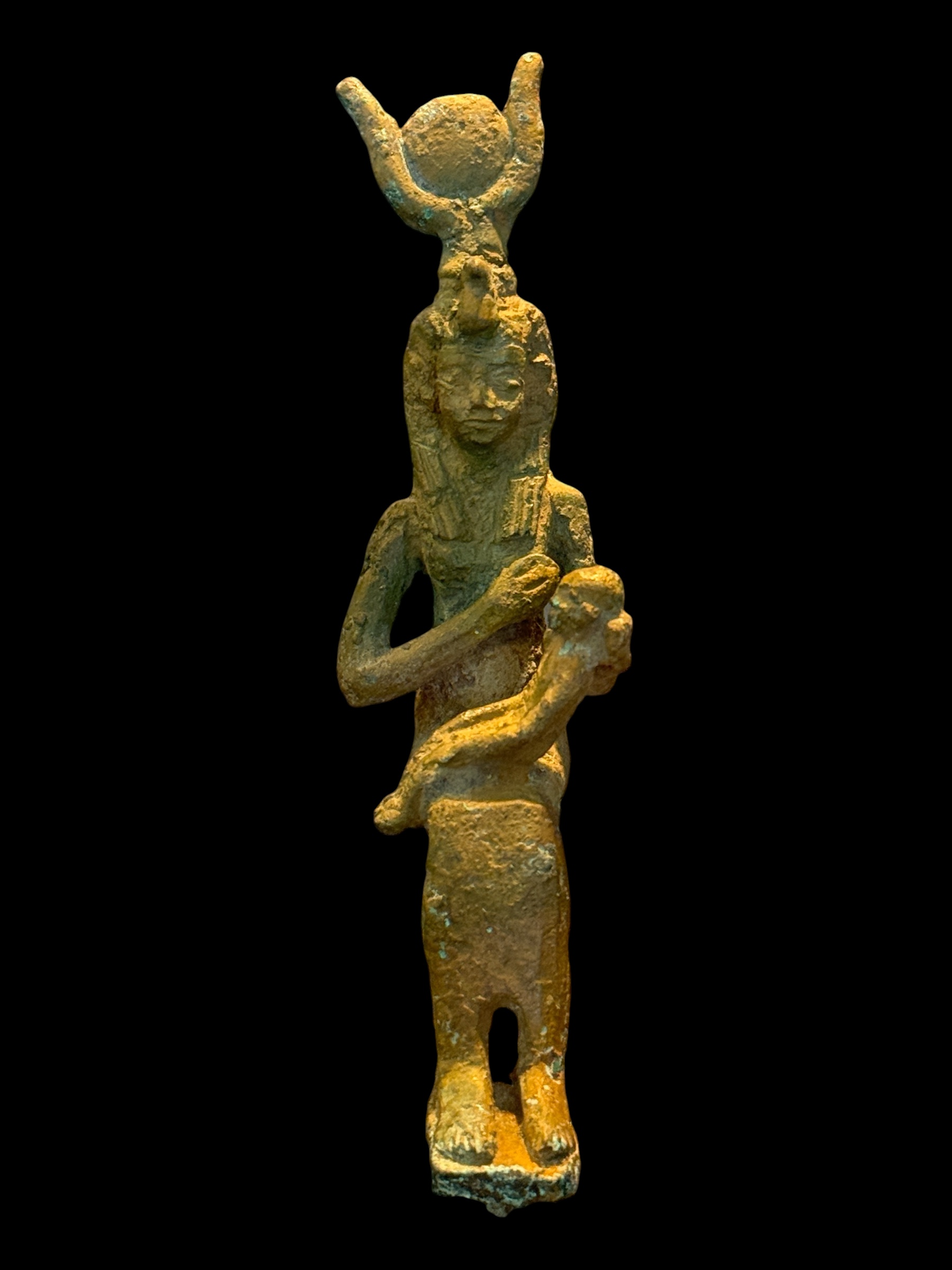
Isis Nursing Horus — Bronze Statuette
Late Period, Dynasty 26–30, ca. 664–332 B.C.
This commanding bronze statuette depicts the goddess Isis enthroned, nursing the infant Horus — one of the most powerful and enduring images in the entire canon of ancient Egyptian art. Known as ‘Isis Lactans’, this iconographic type became the supreme expression of divine motherhood, protection, and royal legitimacy throughout the Late Period and beyond.
Isis is shown seated upon her throne in the traditional pose of maternal authority, wearing the elaborate horned sun-disc crown — the cow horns of Hathor embracing the solar disc — that identifies her as the Queen of Heaven and the universal mother goddess. Her tripartite wig falls in heavy plaits upon her shoulders, and traces of the broad collar (wesekh) are visible across her chest. The infant Horus sits upon her lap, receiving nourishment from his divine mother — an act that simultaneously symbolises the transmission of royal power from mother to son, the protection of the vulnerable, and the eternal cycle of death and rebirth embodied in the Osirian myth.
The surface displays a magnificent patina ranging from deep verdigris green to warm golden-bronze tones, the result of two and a half millennia of natural oxidation. This patina is itself a testament to authenticity — the layered copper carbonates and chlorides that form over centuries cannot be artificially replicated with such depth and variation.
Such bronzes were produced in vast numbers during the Late Period (664–332 B.C.) as votive offerings dedicated in the great temples of Egypt, particularly at sites sacred to Isis such as Philae, Behbeit el-Hagar, and the Iseum at Saqqara. Devotees commissioned these figures as acts of piety, seeking the goddess’s protection and favour. The finest examples, such as this large and well-preserved specimen, demonstrate the extraordinary skill of Egyptian bronze-casters who employed the lost-wax technique to achieve remarkable detail at this scale.
The image of Isis nursing Horus transcended Egyptian religion to become one of the most influential religious images in human history. Scholars have long noted the iconographic continuity between Isis Lactans and early Christian depictions of the Madonna and Child — a visual legacy that speaks to the universal power of this archetype across cultures and millennia.
At 13 cm in height, this is a substantial example of the type, exhibiting fine detail in the crown, facial features, and the relationship between mother and child. Comparable bronzes are held in the collections of the Metropolitan Museum of Art, the British Museum, the Louvre, and the Brooklyn Museum.
Provenance & Details
- •Private collection, acquired prior to 1970.
- •from the Private Collection K. N. H., Switzerland
- •Roeder, Günther, Ägyptische Bronzefiguren, Staatliche Museen zu Berlin, 1956
- •Müller, Hans Wolfgang, Isis mit dem Horuskinde, Münchner Ägyptologische Studien, 1963
- •Tran Tam Tinh, V., Isis Lactans: Corpus des monuments gréco-romains d’Isis allaitant Harpocrate, Études préliminaires aux religions orientales dans l’Empire romain, 1973
- •Metropolitan Museum of Art, New York (acc. 26.7.866)
- •British Museum, London (EA 60756)
- •Brooklyn Museum (37.400E)
- •Louvre, Paris (E 3637)
Enquire