Contemporary Art
Fritz Ruppert — Still Life with Chinoiserie
Oil on canvas, signed and dated 1920, approx. 77 × 90 cm
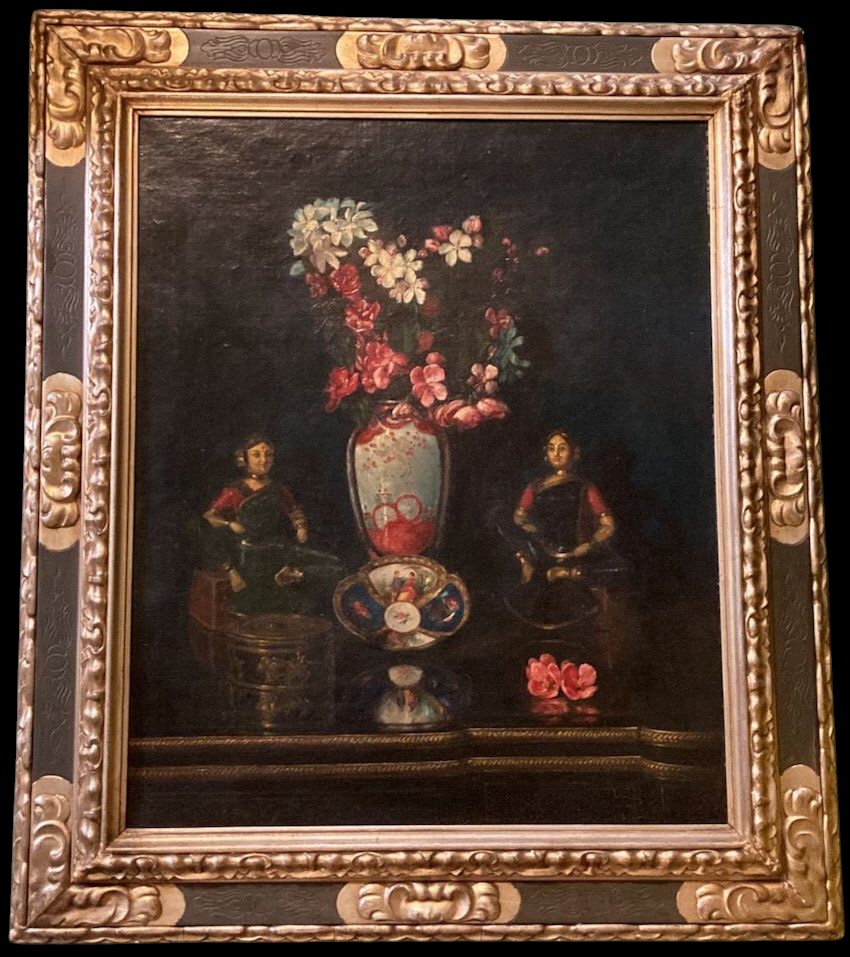
A sumptuous still life by Fritz Ruppert, signed and dated 1920, executed in oil on canvas and presented in its original ornate gilt frame. The painting measures approx. 77 × 90 cm including the frame — a substantial and commanding presence that rewards both distant admiration and close examination.
The composition is a masterful arrangement of Eastern exotica and floral abundance, set against a deep, dark background in the tradition of Dutch and Flemish Old Master still life painting. At the centre stands a Chinese porcelain vase — decorated with red floral medallions on a pale ground — overflowing with a luxuriant bouquet of roses, camellias, and cherry blossoms in shades of red, pink, and white.
Flanking the vase are two Indian nodding-head figures (Wackelfiguren), painted with remarkable detail: each wears a dark sari with vivid red sleeves, gold jewellery, and a bindi — their presence lending an air of exotic mystery to the composition. Before them sits a Japanese Imari porcelain bowl, its interior alive with painted birds and flowers. Pink camellias lie scattered on the polished, reflective surface of the table, their petals glowing against the darkness.
The verso bears the inscription "F. Ruppert. 1920. No 19." in the artist's hand — confirming both authorship and the painting's place within a numbered body of work. The gilt frame, with its baroque scroll corners and laurel-leaf border, is contemporary with the painting and enhances its Old Master quality.
This painting belongs to a tradition of Chinoiserie still life that flourished in European art from the 17th century onwards, reflecting the West's enduring fascination with the arts and artefacts of Asia. Ruppert's handling of light, texture, and colour demonstrates a painter of considerable skill and refined taste.
Provenance & Details
- •Private collection.
- •from the Private Collection K. N. H., Switzerland
- •Hertel, Christiane, Siting China in Germany: Eighteenth-Century Chinoiserie and Its Modern Legacy, Penn State University Press, 2019
- •Roh, Franz, German Art in the 20th Century, Thames & Hudson, 1968
- •Jacobson, Dawn, Chinoiserie, Phaidon Press, 1993
- •Impey, Oliver, Chinoiserie: The Impact of Oriental Styles on Western Art and Decoration, Oxford University Press, 1977
CHINOISERIE AND THE EUROPEAN STILL LIFE TRADITION
The still life genre has a long and distinguished history in European painting, reaching its zenith in the Dutch and Flemish Golden Age of the 17th century. Artists like Willem Kalf, Jan Davidsz. de Heem, and Rachel Ruysch elevated the depiction of everyday objects — flowers, fruit, porcelain, metalwork — to a form of philosophical meditation on beauty, transience, and the pleasures of the material world.
By the early 20th century, this tradition had evolved but not disappeared. Fritz Ruppert's sumptuous still life of 1920 stands firmly within this lineage, combining the dark, atmospheric backgrounds of the Old Masters with a subject matter that reflects centuries of European fascination with the arts of Asia. The Chinese porcelain vase, the Japanese Imari bowl, the Indian nodding-head figures — each element speaks to the phenomenon of Chinoiserie, the Western artistic movement inspired by the decorative arts of China, Japan, and India.
Chinoiserie reached its first peak in the 17th and 18th centuries, when the East India companies of Holland, England, and France flooded European markets with porcelain, lacquerware, silk, and other luxury goods from Asia. European artists and craftsmen responded by incorporating Asian motifs and objects into their own work, creating a hybrid aesthetic that was neither purely Eastern nor Western but something entirely new. This cultural dialogue continued into the 20th century, as artists like Ruppert drew on the accumulated treasures of centuries of collecting to create compositions that celebrated the beauty and exoticism of Asian decorative arts.
The painting's verso inscription — "F. Ruppert. 1920. No 19." — reveals that this work was part of a numbered series, suggesting a systematic and prolific artistic practice. The original gilt frame, with its baroque scroll corners and laurel-leaf border, is contemporary with the painting and enhances its Old Master quality, creating a unified aesthetic experience that transports the viewer into a world of refined taste and cultivated beauty.
Enquire