Contemporary Art
Günther Uecker — "Do It Yourself"
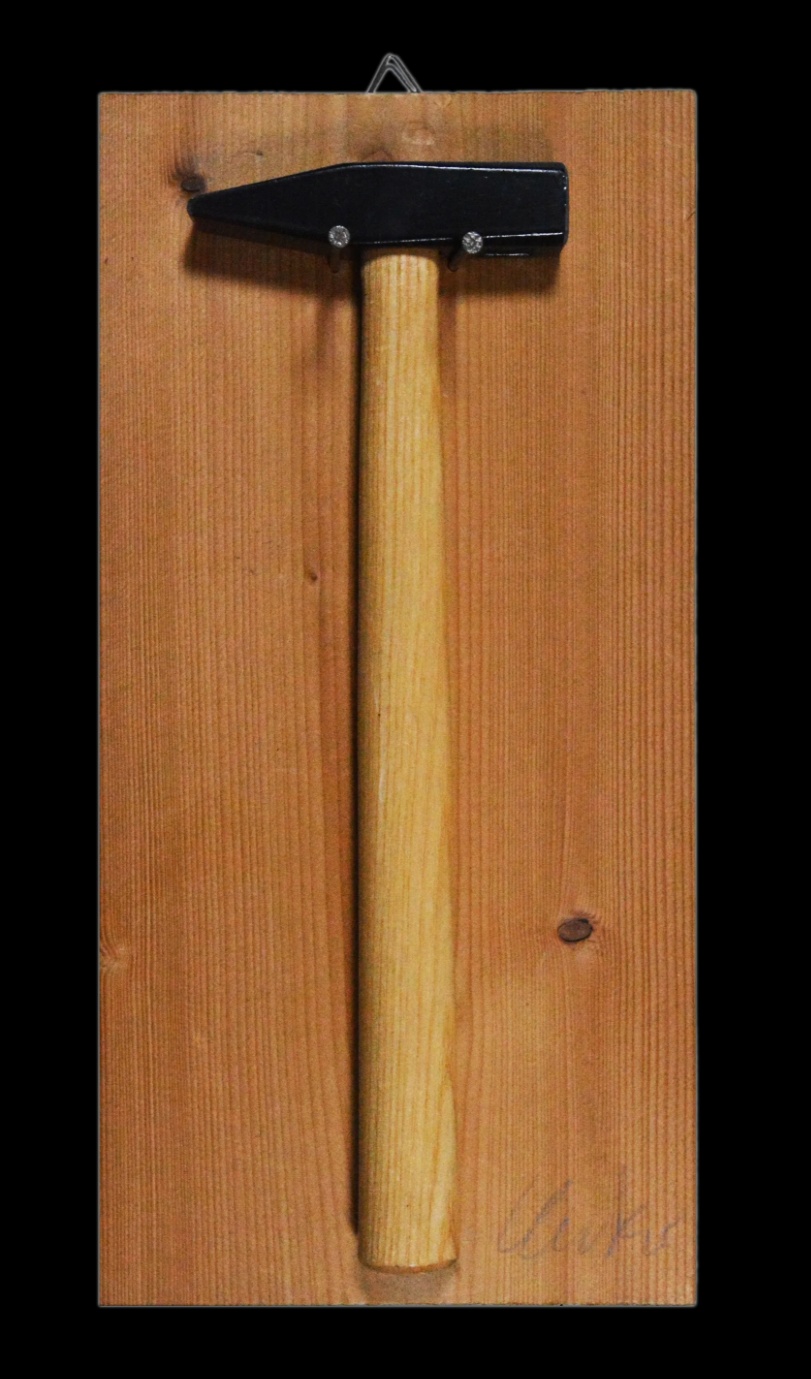
Hammer and Nails on Wood, Edition VICE-Versand, Remscheid
Günther Uecker, born in 1930 in Wendorf, Mecklenburg, is one of the most significant figures in post-war European art. A founding member of the legendary ZERO group alongside Heinz Mack and Otto Piene, Uecker has spent over six decades exploring the expressive potential of the nail — an ordinary industrial object that, in his hands, becomes a vehicle for light, shadow, rhythm, and spiritual intensity. "Do It Yourself" is a quintessential example of this lifelong investigation: a real hammer and two nails mounted on a simple wooden board, signed in pencil by the artist, and published as an edition by VICE-Versand in Remscheid, Germany.
The work is at once disarmingly literal and profoundly conceptual. The title, "Do It Yourself," is an invitation — or perhaps a provocation. It suggests that the act of creation is not the exclusive domain of the artist, but a universal human impulse. By presenting the tools of his own art — the hammer and the nails — Uecker collapses the distance between the maker and the viewer. The work is both a finished sculpture and an unrealised potential, a beginning rather than an end. It is a gesture of radical generosity, offering the viewer not a completed vision, but the means to create one.
Uecker’s relationship with the nail is one of the most sustained and singular dialogues between an artist and a material in the history of modern art. Since the late 1950s, he has driven nails into canvases, furniture, pianos, television sets, and entire rooms, creating surfaces that ripple and undulate with light. The nail, for Uecker, is not a symbol of violence or destruction, but of transformation. It is a point of contact between the human hand and the material world, a mark of energy and intention. In "Do It Yourself," this dialogue is distilled to its essence: the hammer, the nail, the wood — the fundamental trinity of Uecker’s art, presented in a state of pure potentiality.
The edition format is central to the meaning of the work. Like his contemporary Joseph Beuys, Uecker understood the multiple as a democratic instrument, a way of disseminating ideas beyond the confines of the gallery and the museum. Each "Do It Yourself" is not merely a reproduction, but an autonomous work of art, signed by the artist and imbued with the same conceptual weight as his monumental nail reliefs. The wooden board, with its visible grain and natural imperfections, is a deliberate choice — it is the same humble material that Uecker has used throughout his career, a surface that accepts the nail without pretension.
The provenance of this particular example traces to Shapero Modern, the contemporary art division of the distinguished London firm Shapero Rare Books Ltd. This work is a rare opportunity to acquire a piece by one of the most important living European artists, a work that encapsulates, in the most concentrated and elegant form, the central idea of a career that has spanned more than sixty years.
Provenance & Details
- •Shapero Modern (Shapero Rare Books Ltd), London
- •from the Private Collection K. N. H., Switzerland
- •D. Honisch, Uecker, Abrams, New York, 1986
- •G. Uecker, Günther Uecker: Notations, Lévy Gorvy, 2021
- •H. Mack & O. Piene, Zero, MIT Press, 1973
- •D. Honisch & J.E. Bowlt (eds.), Günther Uecker: Schriften, Gedichte, Projektbeschreibungen, Prestel, Munich, 1979
Günther Uecker (born 13 March 1930, Wendorf, Mecklenburg) is a German sculptor and installation artist who became one of the most influential figures in post-war European art. After studying art in Wismar and Berlin-Weissensee, he moved to Düsseldorf in 1953, where he studied under Otto Pankok at the Kunstakademie. In 1961, he joined Heinz Mack and Otto Piene as the third member of the ZERO group, an international movement that sought to break with the gestural expressionism of the post-war period and create a new art based on light, movement, and pure visual phenomena.
Uecker’s signature medium — the nail — emerged in the late 1950s. He began driving nails into canvases, furniture, and everyday objects, creating rhythmic, light-responsive surfaces that oscillated between painting and sculpture. His nail reliefs, often painted white, transform the industrial fastener into an instrument of meditation, their shadows shifting with the movement of light and the viewer’s position. Major institutional works include his redesign of the prayer room at the German Bundestag in Berlin (1999) and his monumental installations at the Kunstsammlung Nordrhein-Westfalen, Düsseldorf.
The “Do It Yourself” edition, published by Edition VICE-Versand in Remscheid, represents Uecker’s engagement with the concept of the artist’s multiple — a democratic art form that makes conceptual works accessible beyond the gallery. Each example consists of a real hammer and two nails mounted on a simple wooden board, signed in pencil by the artist. The title is both an instruction and a philosophical proposition: the viewer is invited to complete the work, to become the artist, to drive the nails into the wood and thereby participate in the creative act that defines Uecker’s entire oeuvre.
This particular example was acquired from Shapero Modern, the contemporary art division of the distinguished London firm Shapero Rare Books Ltd (est. 1979), one of the world’s leading dealers in rare books, prints, and works on paper. The gallery’s modern art programme has placed works by major twentieth-century European artists including Picasso, Miró, Chagall, and members of the ZERO movement.
Uecker’s works are held in over 150 public collections worldwide, including the Museum of Modern Art, New York; the Stedelijk Museum, Amsterdam; the Centre Pompidou, Paris; the Kunstsammlung Nordrhein-Westfalen, Düsseldorf; and the Tate, London. He represented Germany at the Venice Biennale in 1970 and received the Pour le Mérite for Sciences and Arts in 2000.
Enquire