Antiquities
Indus Valley Terracotta Vessel
ca. 2500–1500 B.C., Bronze Age, certified
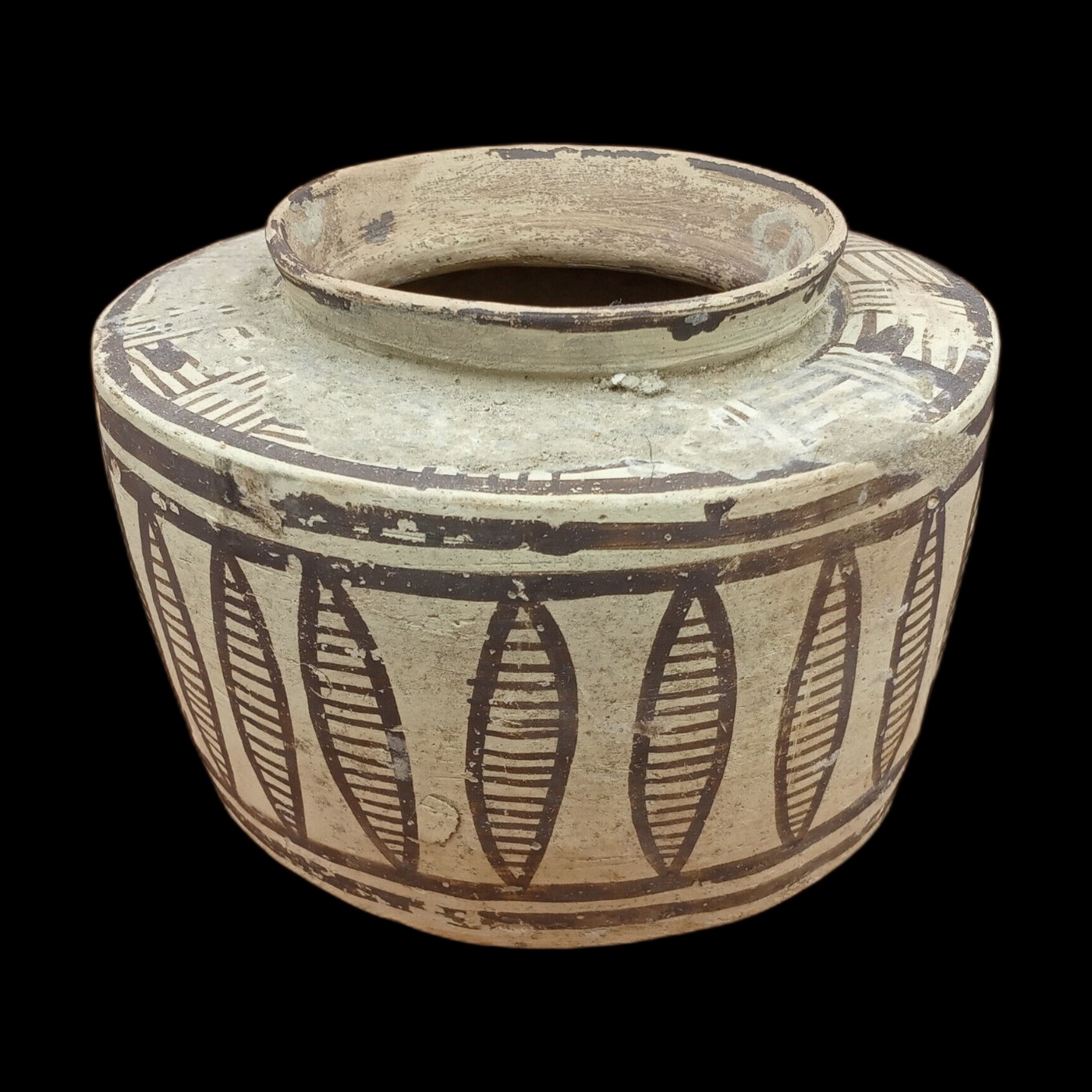
A remarkable terracotta vessel from the Indus Valley Civilization — one of the great cradles of human culture, flourishing along the banks of the Indus River in what is now Pakistan and northwestern India between approximately 2500 and 1500 B.C. This squat, wide-mouthed bowl displays the distinctive geometric decoration that characterizes the finest Indus Valley pottery.
The vessel's body is adorned with bold, dark brown leaf or feather-shaped motifs arranged in a continuous band around the shoulder, each filled with fine horizontal hatching. Above and below, bands of geometric patterns — hatched lines and chevrons — frame the central decoration. The rim bears its own frieze of smaller geometric designs. The overall effect is one of remarkable sophistication and visual rhythm, achieved with an economy of means that speaks to millennia of refined craft tradition.
The condition is near museum grade, with some earthen encrustation consistent with burial or long-term storage — a patina that authenticates rather than diminishes the vessel's value. The terracotta body retains its warm, cream-coloured surface, providing a perfect ground for the painted decoration.
This vessel is accompanied by a Certificate of Authenticity from the Spanish Shipwreck Treasure Co., confirming its dating to the period 2500–1500 B.C. and its origin in the Indus Valley migration region. Objects of this quality and age from the Indus Valley Civilization are increasingly rare on the market, as major museum collections have absorbed much of the available material.
Provenance & Details
- •Private collection, acquired prior to 1970.
- •from the Private Collection K. N. H., Switzerland
- •Pittman, Holly, Art of the Bronze Age: Southeastern Iran, Western Central Asia, and the Indus Valley, The Metropolitan Museum of Art, 1984
- •Kenoyer, Jonathan Mark, Ancient Cities of the Indus Valley Civilization, Oxford University Press, 1998
- •Possehl, Gregory L., The Indus Civilization: A Contemporary Perspective, AltaMira Press, 2002
- •Wright, Rita P., The Ancient Indus: Urbanism, Economy, and Society, Cambridge University Press, 2010
- •Lal, B.B., The Earliest Civilization of South Asia: Rise, Maturity and Decline, Aryan Books International, 1997
THE INDUS VALLEY CIVILIZATION: CRADLE OF URBAN CULTURE
The Indus Valley Civilization, also known as the Harappan Civilization, represents one of humanity's greatest achievements — a vast, sophisticated urban culture that flourished along the Indus River and its tributaries between approximately 3300 and 1300 B.C. At its peak, it encompassed an area larger than ancient Egypt and Mesopotamia combined, with major cities such as Mohenjo-daro and Harappa housing populations of up to 50,000 people.
The pottery of the Indus Valley Civilization is among its most distinctive and beautiful artistic achievements. Characterized by bold geometric patterns painted in dark pigment on light-coloured clay, these vessels demonstrate a sophisticated understanding of form, proportion, and decorative rhythm. The leaf or feather motifs, hatched lines, and chevron patterns that adorn this vessel are part of a decorative vocabulary that was remarkably consistent across the vast geographical extent of the civilization — evidence of shared cultural values and artistic traditions that transcended local boundaries.
The terracotta vessels served both practical and ceremonial purposes. They stored grain, water, and other commodities in the carefully planned granaries and warehouses of Harappan cities. They accompanied the dead in burial rituals. And they served as canvases for artistic expression, their painted surfaces carrying symbolic meanings that we are still working to decode.
The certification by the Spanish Shipwreck Treasure Co. places this vessel within a documented chain of custody, confirming its antiquity and its origin in the Indus Valley migration region. As major museum collections have absorbed much of the available Indus Valley material, objects of this quality and authenticity become increasingly rare on the open market — making each certified example a precious link to one of the foundational civilizations of human history.
Enquire