Old Masters
The Last Supper — Italian School
Oil on canvas, wax-lined, 64.5 × 96.5 cm
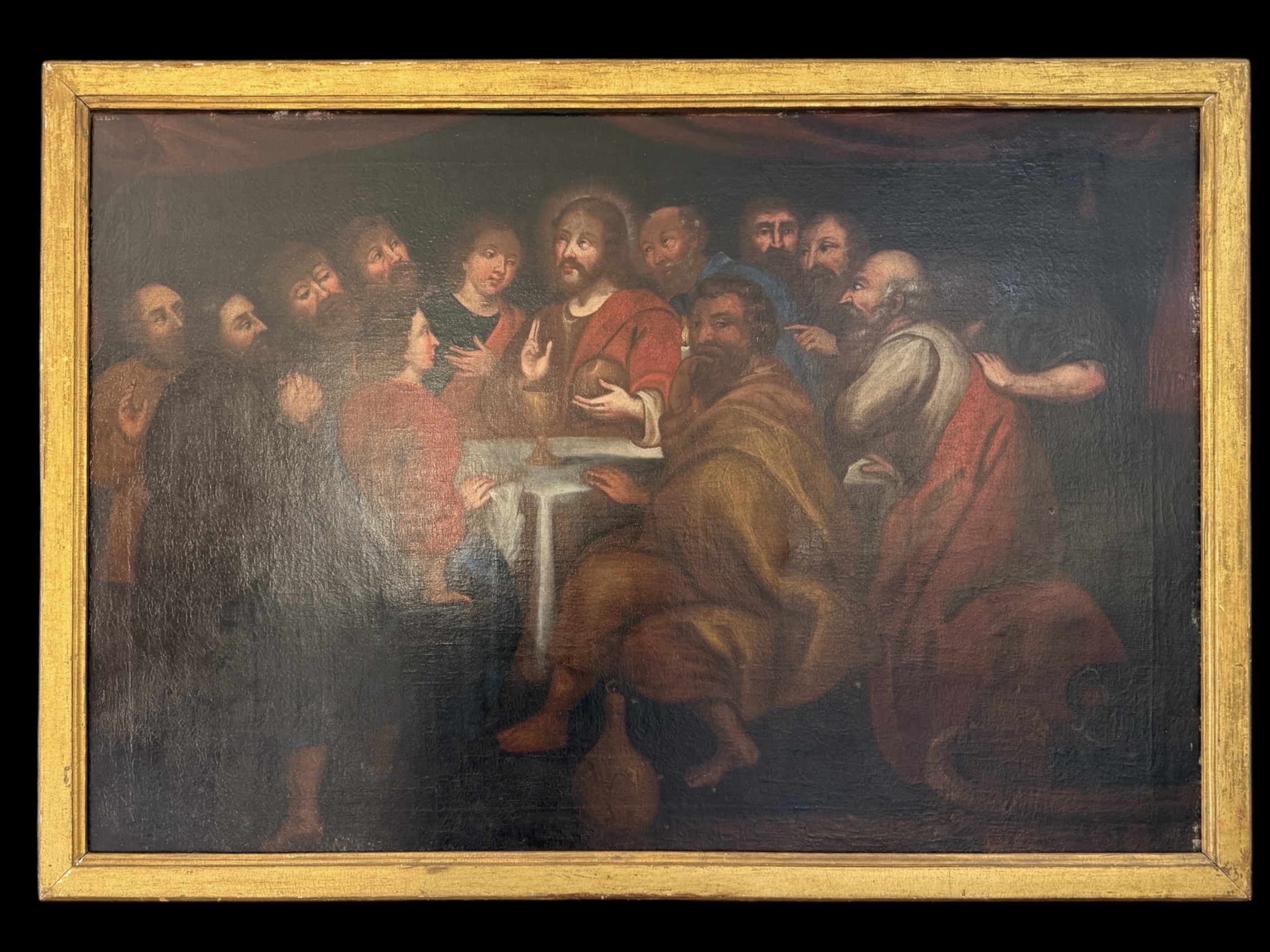
This commanding oil painting presents the Institution of the Eucharist — the moment at which Christ, surrounded by His twelve apostles, raises the chalice and pronounces the words that would become the central sacrament of the Christian faith. Executed by an accomplished hand of the Italian School in the seventeenth century, the composition abandons the traditional frieze-like arrangement of figures along a horizontal table in favour of a tightly compressed, emotionally charged grouping that draws the viewer directly into the sacred drama.
Christ occupies the compositional centre, distinguished by a subtle nimbus and the rich crimson of His robe. His right hand is raised in a gesture of blessing while His left cradles the golden chalice — the focal point around which the entire narrative revolves. The young Saint John leans toward Him with clasped hands, his youthful features and dark garment providing a poignant contrast to the weathered faces of the older apostles.
The artist demonstrates a sophisticated understanding of chiaroscuro, employing deep shadows to create volumetric forms and direct the viewer's eye toward the illuminated centre. The palette is restrained yet rich — earth tones of ochre and umber punctuated by passages of vermilion, crimson, and the cool blue of individual garments. The drapery is rendered with confident, broad brushwork that suggests the influence of the Venetian school, while the dramatic lighting and tightly grouped figures reflect the Baroque sensibility of the Seicento.
The circular grouping of figures — departing from the linear arrangement popularised by Leonardo's celebrated fresco (1495–1498) — creates an intimate, almost claustrophobic intensity that heightens the emotional weight of the moment. This compositional choice, combined with the pronounced tenebrism and naturalistic rendering of individual physiognomies, places the work firmly within the tradition of seventeenth-century Italian devotional painting.
The canvas has been wax-lined (wachsdoubliert), a conservation technique widely employed from the eighteenth century onwards to stabilise fragile original canvases. The gilt frame, with its classical moulding profile, is consistent with Italian framing traditions and complements the warm tonality of the painting. The paint surface exhibits the characteristic craquelure and patina of considerable age.
Provenance & Details
- •Swiss private collection.
- •Fischer Auction House, Lucerne, Switzerland.
- •from the Private Collection K. N. H., Switzerland
- •Castagno, Andrea del, Last Supper, 1445–1450, Fresco, Cenacolo di Sant’Apollonia, Florence
- •Leonardo da Vinci, The Last Supper, 1495–1498, Tempera on gesso, Santa Maria delle Grazie, Milan
- •Hall, James, Dictionary of Subjects and Symbols in Art, John Murray, London, 1974
- •Schiller, Gertrud, Iconography of Christian Art, Vol. II: The Passion of Jesus Christ, Lund Humphries, 1972
- •Borsook, Eve, The Mural Painters of Tuscany: From Cimabue to Andrea del Sarto, Oxford University Press, 1980
Enquire