Contemporary Art
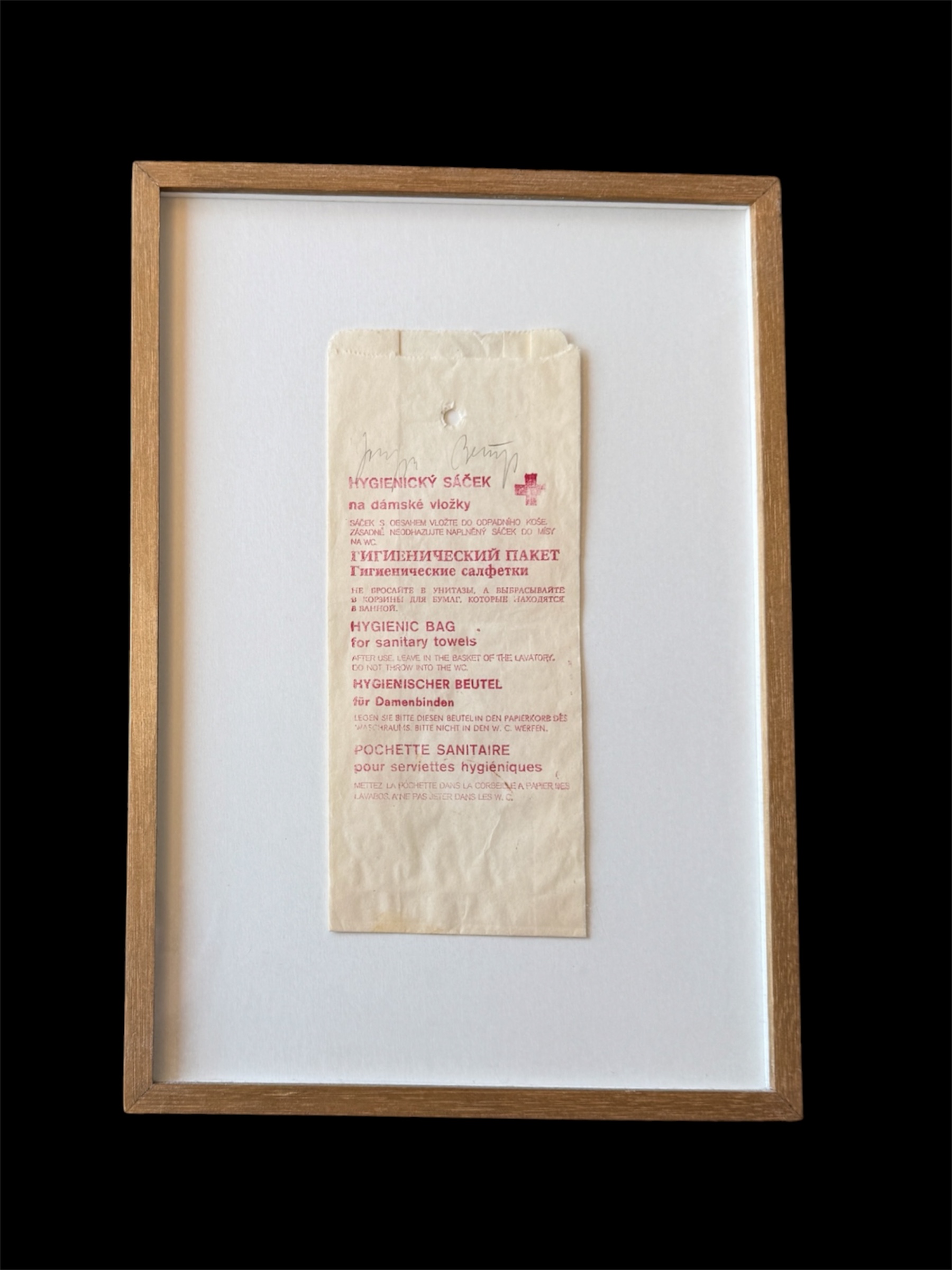
Joseph Beuys — Hygienicky Sácek
Germany, 1980 | Signed Multiple
A hand-signed paper hygiene bag by Joseph Beuys (1921 Krefeld – 1986 Düsseldorf), one of the most influential and radical artists of the twentieth century. Signed in pencil at the upper edge, this multilingual printed bag — bearing text in Czech, Russian, English, German and French — is a characteristic example of Beuys’s conceptual multiples: ordinary, mass-produced objects elevated to the status of art through the artist’s intervention.
Between 1965 and his death in 1986, Beuys created over 600 multiples catalogued in the definitive catalogue raisonné edited by Jörg Schellmann. Unlike traditional prints or sculptures produced in limited editions, Beuys’s multiples were conceived as “vehicles for ideas” — democratic carriers of meaning that could reach audiences far beyond the gallery walls. A felt suit, a block of fat, a bar of chocolate, a paper bag: each object became a node in Beuys’s expanded concept of art, which he termed Soziale Plastik (Social Sculpture).
Why did Beuys sign everyday objects?
For Beuys, the signature was not merely an authentication but an act of transformation. By signing a utilitarian object, he collapsed the boundary between art and life — the central tenet of his philosophy that “every human being is an artist.” The Hygienicky Sácek, a disposable sanitary bag found in hotels across the Eastern Bloc, is precisely the kind of anonymous, overlooked object that Beuys chose to redeem. Its multilingual text — a relic of Cold War-era standardisation — becomes, through his intervention, a document of cultural exchange and a meditation on the hidden economies of everyday life.
What is the Wirtschaftswert-Prinzip?
This work relates directly to Beuys’s Wirtschaftswert-Prinzip (Economic Value Principle), a conceptual project developed in the 1970s in which ordinary consumer goods were presented as museum artefacts. By stripping objects of their original function and placing them in an artistic context, Beuys critiqued capitalist value systems and argued for a human-centred economy in which creativity — not market forces — determines worth.
What makes this piece exceptional?
Beuys’s signed multiples are held in major museum collections worldwide, including the Museum of Modern Art, New York; Tate Modern, London; the Hamburger Bahnhof, Berlin; and the Pinakothek der Moderne, Munich. As the market for post-war conceptual art continues to mature, authenticated Beuys multiples have become increasingly sought after by both institutional and private collectors. This example, professionally framed and in very good condition, represents an accessible yet historically significant entry point into the work of one of the twentieth century’s most transformative artistic minds.
Provenance & Details
- •Schellmann, J. (Hrsg.), Joseph Beuys – Die Multiples: Werkverzeichnis der Druckgraphik und der Multiples, Edition Schellmann, München/New York, 1971–2020 (9. Auflage online)
- •Adriani, G., Konnertz, W. & Thomas, K., Joseph Beuys: Leben und Werk, DuMont, Köln, 1981
- •Tisdall, C., Joseph Beuys, Solomon R. Guggenheim Museum, New York, 1979
- •Bastian, H., Joseph Beuys: Skulpturen und Objekte, Prestel, München, 1988
Enquire