Contemporary Art
Joseph Beuys — "Intuition"
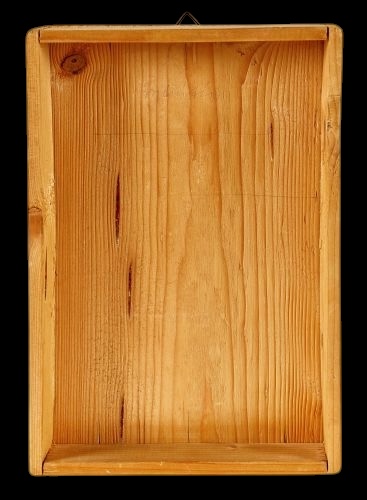
Wooden Box with Pencil Drawing, 1968
In the tumultuous year of 1968, a period of profound social and political upheaval, Joseph Beuys, a figure who would irrevocably shape the course of post-war European art, conceived a work that was both deceptively simple and conceptually vast: "Intuition". This object, a plain wooden box with a lid, bearing only the titular word and two hand-drawn lines in pencil, is far more than a mere container. It is a vessel for an idea, a challenge to the very definition of art, and a profound statement on the nature of human creativity. Presented by HUBER FINE ART, this particular example from the unlimited edition created for Vice-Versand stands as a powerful testament to Beuys's revolutionary concept of "social sculpture" and his unwavering belief in the latent artistic potential within every individual.
Beuys’s art cannot be separated from his life. A former Luftwaffe pilot who was shot down over Crimea during World War II, he was rescued by nomadic Tatars who, according to his own mythologized account, wrapped him in animal fat and felt to save his life. This experience of trauma and regeneration became the crucible for his artistic vocabulary, with materials like felt, fat, and wood imbued with deep symbolic meaning. The "Intuition" box, crafted from simple, unadorned wood, speaks to this vocabulary. It is a humble, organic material, yet it forms a structure, a container for thought. The two pencil lines, drawn with a deliberate, almost primal simplicity, are not a depiction of anything, but rather a mark of human presence, a gesture. As Beuys himself stated, the open box suggests "energy directed towards or..." – an invitation for the viewer to complete the equation, to fill the void with their own thoughts, ideas, and, as the title commands, intuition.
The concept of the "multiple" was central to Beuys’s democratic vision for art. In an era when the art world was often perceived as an exclusive and elitist domain, Beuys sought to break down these barriers. By creating unlimited editions of works like the "Intuition" box, he made his art accessible to a wider audience, transforming the artwork from a unique, precious object into a vehicle for the dissemination of ideas. This was not a commercial calculation, but a pedagogical one. Each owner of an "Intuition" box was not merely a collector, but a participant in Beuys’s grand project of social sculpture. The box was a tool, a catalyst for creative thinking, a reminder that the most profound works of art are not necessarily those found in museums, but those that unfold within the landscape of the human mind.
To own an "Intuition" box is to hold a piece of conceptual art history. It is an object that challenges us to look beyond the surface, to question our assumptions about what art is and where it resides. It is a quiet, unassuming object, yet it contains a universe of potential. In a world saturated with noise and distraction, Beuys’s "Intuition" box is a radical call for introspection, a space for quiet contemplation, and a powerful affirmation of the creative spirit that resides within us all. As presented by HUBER FINE ART, this work is not just an artifact of a bygone avant-garde, but a timeless and urgent invitation to engage with the world, and with ourselves, in a more creative and intuitive way.
Provenance & Details
- •Schellmann, Jörg, ed., Joseph Beuys: The Multiples, Catalogue Raisonné of Multiples and Prints 1965-1986, 8th ed., Schellmann & Klüser and New York University Press, Munich and New York, 1997
- •Adriani, Götz, Winfried Konnertz, and Karin Thomas, Joseph Beuys: Life and Works, Barron's, Woodbury, N.Y., 1979
- •Walker Art Center, In the Spirit of Fluxus, Walker Art Center, Minneapolis, 1993
- •Higgins, Hannah, Fluxus Experience, University of California Press, Berkeley, 2002
- •Los Angeles County Museum of Art, Art of Two Germanys/Cold War Cultures, Los Angeles County Museum of Art, Los Angeles, 2009
- •Selz, Peter, German Art from Beckmann to Richter, Skira, Milan, 2013
Joseph Beuys (1921–1986) is one of the most influential and controversial artists of the twentieth century. A central figure in the Fluxus movement and a pioneer of conceptual and performance art, Beuys expanded the definition of art to encompass social sculpture — the idea that art should actively shape society and politics. His famous declaration that 'every human being is an artist' was not a statement about painting or sculpture, but a radical proposition about human creativity and social responsibility. Beuys's work drew deeply on his personal mythology, particularly his wartime experiences as a Luftwaffe pilot, and employed materials — felt, fat, honey, copper — that carried intense symbolic and autobiographical meaning.
The 'Intuition' wooden box, created in 1968, is one of Beuys's most widely distributed multiples — editions of artworks produced in large numbers to democratise access to art. The concept of the multiple was central to Beuys's philosophy: by producing affordable editions, he sought to break down the barriers between art and everyday life. Each 'Intuition' box bears a pencil drawing by Beuys on the interior, transforming a simple wooden container into a vessel of artistic and philosophical meaning. The year 1968 was a watershed moment in European culture — a year of student revolts, political upheaval, and radical questioning of established institutions. Beuys was at the centre of this ferment, using his art and his public persona to challenge the boundaries between art, education, and political action.
Enquire