Natural History
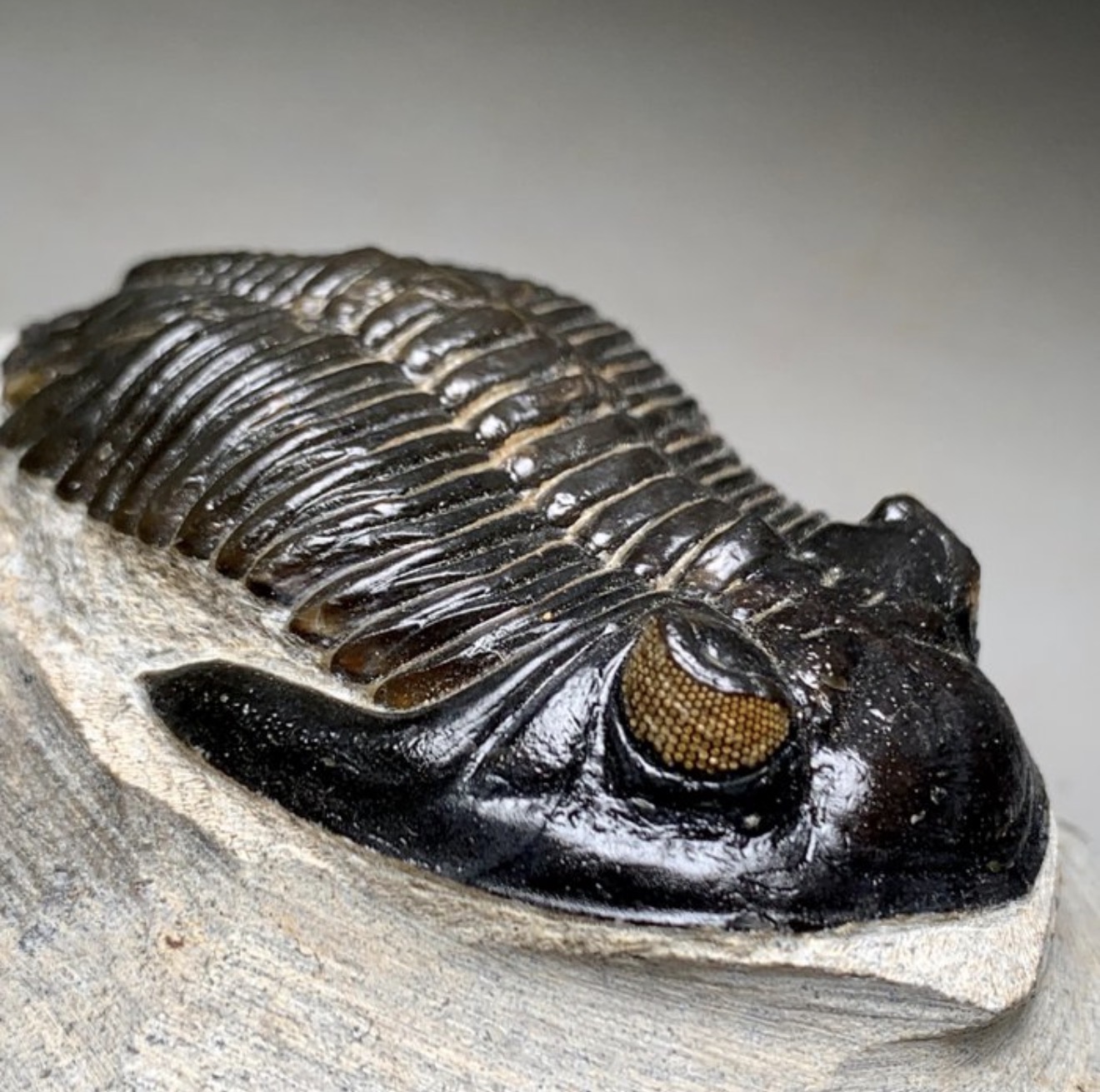
Metacanthina issoumourensis — Devonian Phacopid Trilobite
Middle Devonian, ca. 393–383 Million Years, Morocco
A superbly preserved specimen of Metacanthina issoumourensis, a phacopid trilobite from the Middle Devonian (Eifelian–Givetian) of southeastern Morocco. This arthropod inhabited the shallow marine environments of the Palaeotethys Ocean approximately 390 million years ago, during an era when trilobites had reached the zenith of their morphological diversity.
The specimen displays exceptional three-dimensional preservation with its characteristic schizochroal compound eyes remarkably intact. These sophisticated visual organs — unique to the suborder Phacopina — consist of individually lensed units, each covered by a separate cornea, representing one of the most advanced optical systems in the fossil record (Clarkson, Levi-Setti & Horváth, 2006). The golden-amber calcite lenses are clearly visible, arranged in a precise hexagonal array that would have afforded the living animal near-360° vision across the Devonian seafloor.
The exoskeleton exhibits the diagnostic features of the genus: a well-defined cephalon with prominent genal spines, a segmented thorax of eleven articulated pleurae, and a semicircular pygidium. The specimen has been expertly prepared from its limestone matrix near Alnif in the Jbel Issoumour region — one of the world's most prolific Devonian trilobite localities (Chatterton et al., 2006). The deep black calcite preservation against the pale grey matrix creates a striking visual contrast that highlights the anatomical detail.
Minor conservation work has been undertaken to rejoin the matrix halves — a common necessity with specimens from this formation, where natural fracture planes bisect the nodules during extraction. The join line is minimal and does not affect the fossil itself.
Why Are Trilobite Eyes So Remarkable?
The schizochroal eyes of phacopid trilobites represent one of the most extraordinary optical systems ever evolved. Unlike the holochroal eyes found in most other trilobite orders — which possess thousands of tiny, tightly packed lenses beneath a single corneal membrane — schizochroal eyes consist of relatively few, large, individually separated lenses, each with its own cornea. The lenses are composed of single crystals of calcite, oriented along the optical axis to minimise double refraction — a solution so elegant that it was not rediscovered by human engineers until the 17th century (Clarkson & Levi-Setti, 1975). Some phacopid lenses even incorporate a doublet structure with a magnesium calcite cap that corrects for spherical aberration, achieving optical perfection that modern lens designers would recognise (Clarkson, Levi-Setti & Horváth, 2006).
What Was the Devonian World Like?
Approximately 390 million years ago, when this trilobite lived, the Earth was a profoundly different place. The continents were clustered in the southern hemisphere, and the region that is now Morocco lay beneath a warm, shallow tropical sea teeming with life. Trilobites shared these waters with brachiopods, crinoids, corals, and early fish. The Devonian period (419–359 million years ago) is often called the “Age of Fishes,” but it was equally an age of extraordinary arthropod diversity. Trilobites had already been evolving for over 100 million years by this point, and the phacopids represented the pinnacle of their morphological sophistication. Within a few tens of millions of years, however, the great Devonian extinctions would dramatically reduce trilobite diversity, and the group would never again achieve the variety and abundance of this golden age.
Provenance & Details
- •Chatterton, B.D.E. et al., Palaeontographica Canadiana 25, 2006
- •Klug, C., Schulz, H. & De Baets, K., Acta Palaeontologica Polonica 54(1), 2009
- •Clarkson, E., Levi-Setti, R. & Horváth, G., Arthropod Structure & Development 35(4), 2006
- •McKellar, R.C. & Chatterton, B.D.E., Palaeontographica Canadiana 28, 2009
Enquire