Antiquities
Neolithic Flint Nucleus — Grand-Pressigny, "Livre de Beurre"
Late Neolithic, ca. 2700 BC, Grand-Pressigny, Touraine, France
The Factory of the Stone Age: A Grand-Pressigny Flint Nucleus
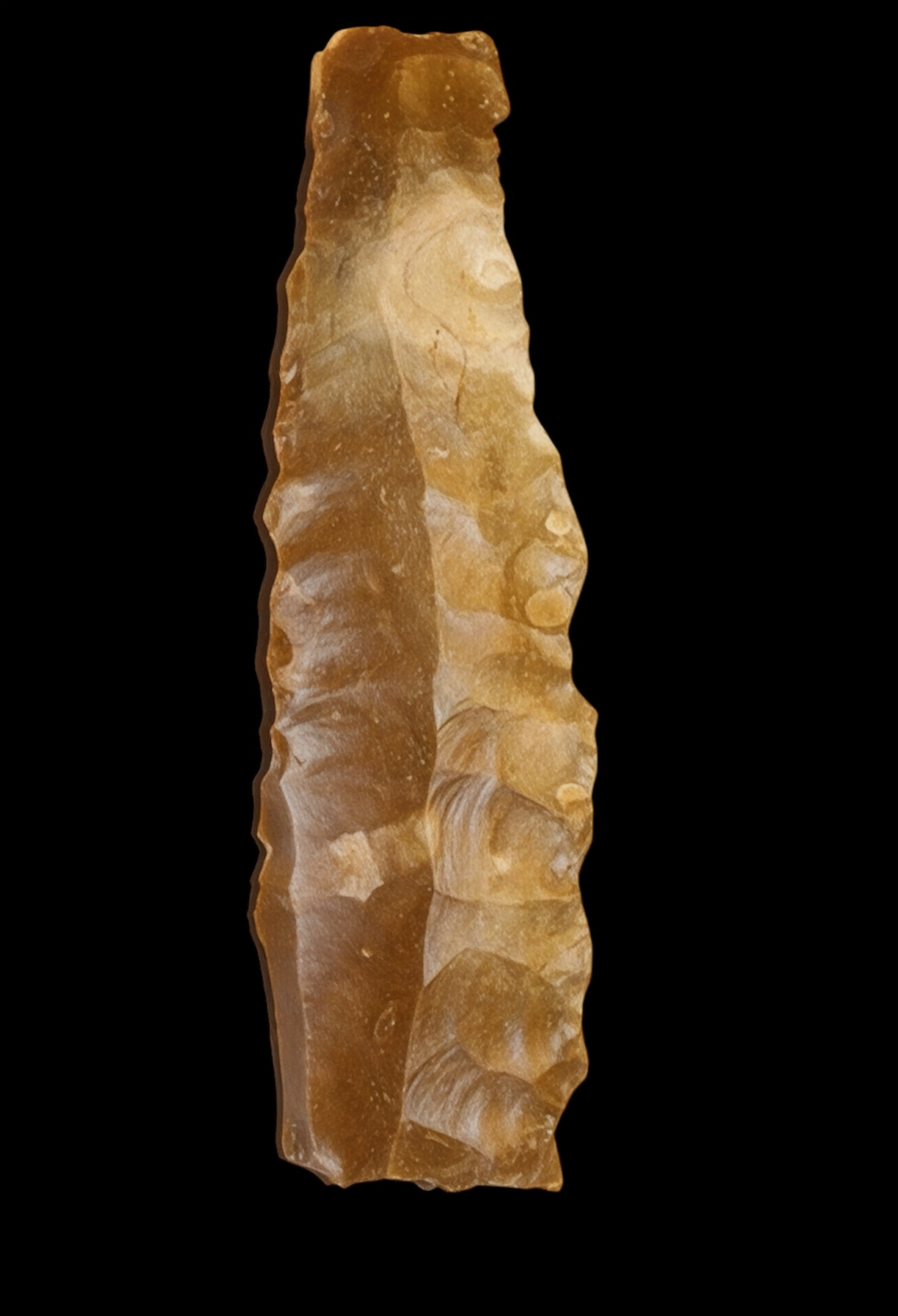
A substantial Neolithic flint nucleus (core) from the celebrated workshops of Grand-Pressigny in the Touraine region of central France — one of the most important centres of prehistoric blade production in all of Europe. The core measures 29 × 7.5 cm and weighs 2.050 kg, fashioned from the distinctive honey-coloured Turonian flint that made Grand-Pressigny famous across the ancient world.
The nucleus preserves a large blade scar on its left face (approx. 20.5 × 3.2 cm), while the opposite side retains the preparatory flaking surfaces, offering a rare and instructive view of the knapping sequence before the final extraction of blades. This type of core is known in French archaeological literature as a "livre de beurre" (pound of butter), a term coined in the 19th century to describe the characteristic elongated, tabular shape of these prepared nuclei, from which master knappers struck long, regular blades of extraordinary quality.
Why Were These Nuclei Made?
Grand-Pressigny was, in essence, an industrial centre of the Late Stone Age. The sole purpose of preparing a nucleus like this one was to extract from it a series of long, thin, perfectly regular blades — the most sophisticated cutting tools available to Neolithic humanity. The process was neither random nor simple: it required years of apprenticeship, an intimate knowledge of the stone's internal structure, and extraordinary precision. A master knapper would first shape the raw flint nodule into the characteristic "livre de beurre" form through careful preparatory flaking — the very traces visible on the intact side of this nucleus. Then, using an indirect percussion technique with a punch of antler or hardwood and a heavy stone hammer, the artisan would strike a single, controlled blow at the platform edge, detaching a blade in one clean motion. From a single well-prepared nucleus, a skilled craftsman could extract between five and ten usable blades, each up to 25–35 cm long and only a few millimetres thick — razor-sharp along both edges.
What Were the Blades Used For?
The long blades produced from Grand-Pressigny nuclei served a remarkable range of purposes in Neolithic daily life. Their primary function was as cutting tools: mounted in wooden or bone handles with birch-bark tar or natural resin, they became sickles for harvesting cereals — wheat, barley, and einkorn — the staple crops of Europe's first farming communities. Use-wear analysis under high-powered microscopes has revealed the characteristic "sickle gloss" on many Grand-Pressigny blades, a distinctive polish caused by prolonged contact with silica-rich plant stems. Other blades served as butchering knives for processing game and livestock, as hide-scrapers for leather working, and as woodworking tools for shaping timber in the construction of longhouses and lake-dwellings. The largest and finest blades, however, transcended mere utility. They were transformed into prestige daggers — status symbols of Neolithic elites. These daggers, often found in wealthy graves across Switzerland, the Paris Basin, and the Low Countries, were too long and too finely made for practical use. They were objects of power and display, the Neolithic equivalent of a ceremonial sword, signalling the wealth, connections, and social standing of their owner. The fact that Grand-Pressigny flint was traded over distances of 500–700 kilometres — from the Loire Valley to the Swiss lake-dwellings, to Belgium, and even to the coasts of Brittany and the Netherlands — speaks to the immense value placed on this material. In an age before metal, before wheeled transport, before written language, the honey-coloured flint of Grand-Pressigny was one of the most sought-after raw materials in all of Europe.
The Grand-Pressigny flint industry reached its zenith during the Final Neolithic, circa 3000–2400 BC, when specialised artisans produced blades up to 35 cm in length — among the longest stone tools ever made by human hands. These blades were traded over vast distances, reaching Switzerland, Belgium, the Netherlands, and even northern Germany, forming one of the earliest long-distance exchange networks in European prehistory. The distinctive caramel-coloured Turonian silex is instantly recognisable and has been identified at hundreds of archaeological sites across western and central Europe.
This nucleus was acquired in 1998 from a French collector (Mr. L), who had been active in surface prospection since 1945. It originates from the locality known as "La Catière" in the Grand-Pressigny area — a well-documented prehistoric workshop site.
Provenance & Details
- •French private collector (Mr. L), active in surface prospection since 1945; acquired 1998
- •from the Private Collection K. N. H., Switzerland
- •Martin, H. (1905). 'Étude sur les Livres de Beurre du Grand-Pressigny.' Bulletin de la Société préhistorique de France, 2, pp. 104–108
- •Millet-Richard, L.-A. (2004). 'Les artisans-tailleurs de la région du Grand-Pressigny au IIIe millénaire av. J.-C.' Cahier des thèmes transversaux ArScAn, V
- •Pelegrin, J. (2002). 'La production des grandes lames de silex du Grand-Pressigny.' In: Guilaine, J. (ed.), Matériaux, productions, circulations du Néolithique à l'Âge du Bronze. Errance, Paris, pp. 131–148
- •Mallet, N. (1992). Le Grand-Pressigny: ses relations avec la civilisation Saône-Rhône. Supplément au Bulletin de la Société des Amis du Musée du Grand-Pressigny