Antiquities
Phoenician-Punic Limestone Stele Fragment with Tanit Symbol
4th Century B.C., Carthage / Western Mediterranean
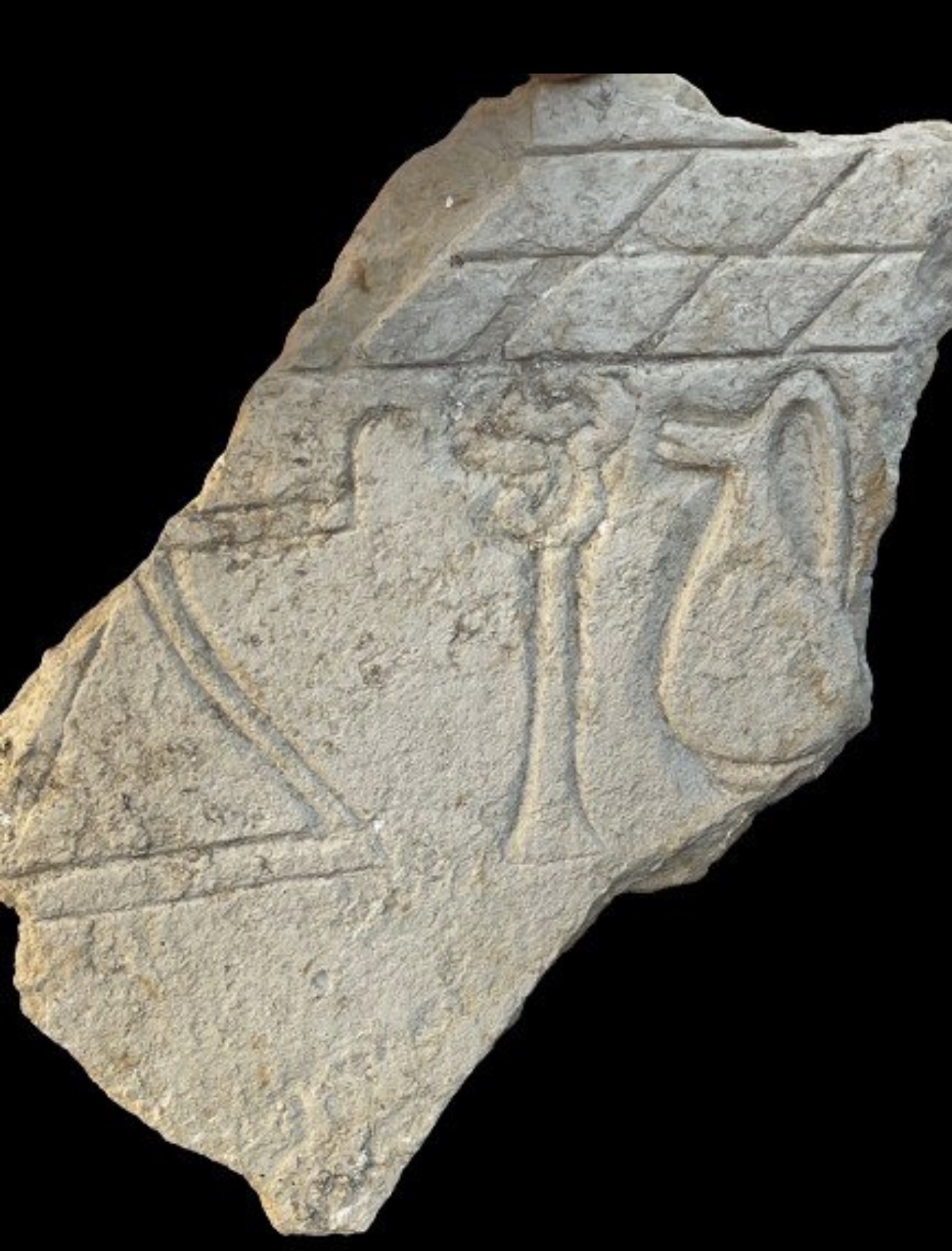
This tapering limestone stele fragment preserves one of the most potent religious symbols of the ancient Western Mediterranean: the Sign of Tanit. Deeply incised into the prepared face of the stone, the anthropomorphic symbol — a triangle surmounted by a horizontal bar with upturned terminals and a disc — represents the supreme female deity of Carthage, Tanit Pene Baal ('Face of Baal'). She was the consort of Baal Hammon and, by the fourth century B.C., had eclipsed him as the principal object of devotion in the Punic world.
The composition is flanked by a caduceus — a winged staff entwined by serpents — a symbol that in Punic iconography carried associations of divine protection, healing, and safe passage between worlds. To the other side, traces of an open palm (the 'Hand of Tanit') are discernible, an apotropaic gesture intended to ward off evil and invoke the goddess's blessing. The upper register is filled with a deeply incised diamond lattice pattern, a decorative motif frequently encountered on votive stelae from the Tophet sanctuaries of Carthage, Hadrumetum, and the Punic colonies of Sardinia and Ibiza.
Stelae of this type were erected in the Tophet — the sacred open-air precinct dedicated to Tanit and Baal Hammon — as votive offerings. The Tophet of Salammbô in Carthage, excavated from the 1920s onwards, yielded thousands of such monuments spanning the seventh to second centuries B.C. Each stele marked a vow fulfilled or a sacrifice offered; the iconographic programme evolved over time from simple bottle-shaped markers to elaborate compositions incorporating the Sign of Tanit, caducei, hands, crescent moons, and architectural elements.
The fourth century B.C. represents the zenith of Carthaginian power. Under the Magonid and later Barcid dynasties, Carthage controlled a maritime empire stretching from the Libyan coast to southern Iberia, with major colonies on Sicily, Sardinia, and the Balearic Islands. The island of Ibiza (Ebusus) was a particularly important centre of Tanit worship — the Cueva d'Es Cuieram sanctuary has yielded hundreds of terracotta figurines of the goddess. The Spanish export licence accompanying this piece is consistent with a Western Mediterranean findspot, possibly from one of the Punic settlements on the Balearic Islands or the Iberian coast.
Comparable stelae are held in the collections of the British Museum, London (reg. 1927,0922.1 — a tapering limestone stele fragment with Tanit symbol flanked by hand and caduceus, excavated at Carthage); the Musée National du Bardo, Tunis; the Museo Archeologico Nazionale, Cagliari (from the Tophet of Tharros, Sardinia); and the Museu d'Arqueologia de Catalunya, Barcelona (from Ibiza). The British Museum example, published by Mendleson (2003), is virtually identical in composition and technique to the present piece.
The limestone medium, the incised technique, and the iconographic programme are entirely consistent with fourth-century B.C. Punic votive practice. The weathering pattern and patina indicate prolonged burial, while the clean break lines suggest the stele was originally taller — likely terminating in a pointed or triangular apex, as is typical of the genre.
Above all, the Sign of Tanit is a symbol of protection. For the Carthaginians, it embodied the sheltering power of the Great Goddess herself — a divine shield against misfortune, illness, and malevolent forces. The open palm flanking the central motif reinforces this apotropaic function: it is the Hand of Tanit, raised to deflect evil and bestow the goddess's blessing upon the faithful. The caduceus, with its intertwined serpents, carried the promise of safe passage and healing. Together, these three elements — the Sign, the Hand, and the Staff — formed a comprehensive programme of spiritual protection that the ancient Carthaginians believed would guard their families, their homes, and their most sacred spaces.
For over two thousand four hundred years, this stone has carried the concentrated protective intention of an entire civilisation. To acquire such an object is not merely to own a fragment of ancient art — it is to bring into one's home a symbol that has served as a guardian since the age of Hannibal and Hamilcar. The protective power attributed to the Sign of Tanit transcends its historical context: it speaks to a universal human desire for safety, blessing, and the sheltering presence of something greater than ourselves. Displayed in a private residence, this stele continues its ancient function — a silent sentinel, a stone guardian, a tangible connection to one of antiquity's most powerful traditions of divine protection.
Provenance & Details
- •Private Collection, Great Britain (acquired ca. 1970s, held for approximately 50 years)
- •Spanish Export Licence
- •Acquired at auction
- •Mendleson, C., Catalogue of Punic Stelae in the British Museum, British Museum Occasional Paper 98, London, 2003
- •Moscati, S. (ed.), The Phoenicians, Bompiani/Abbeville Press, Milan/New York, 1988
- •Harden, D. B., The Phoenicians, Penguin Books, London, 1971
- •Brown, S. H., Late Carthaginian Child Sacrifice and Sacrificial Monuments in their Mediterranean Context, Sheffield Academic Press, 1991
- •Aubet, M. E., The Phoenicians and the West: Politics, Colonies and Trade, Cambridge University Press, 2001
- •Lancel, S., Carthage: A History, Blackwell, Oxford, 1995
- •Miles, R., Carthage Must Be Destroyed: The Rise and Fall of an Ancient Civilization, Viking, London, 2010
- •Turfa, J. M. I., Two Punic Stelae Rediscovered in Philadelphia, Near Eastern Archaeology 82(1), 2019
- •British Museum, London (reg. 1927,0922.1 — tapering limestone stele fragment with Tanit symbol flanked by hand and caduceus, excavated at Carthage, 4th–2nd C. B.C.)
- •Musée National du Bardo, Tunis (Tophet of Salammbô stelae collection)
- •Museo Archeologico Nazionale, Cagliari (Tophet of Tharros, Sardinia)
- •Museu d'Arqueologia de Catalunya, Barcelona (Punic stelae from Ibiza)
- •Museo Puig des Molins, Ibiza (Tanit cult objects from Cueva d'Es Cuieram)