Coins
Postumus Antoninianus — FELICITAS AVG
Roman Empire, Treveri Mint, 260–269 AD
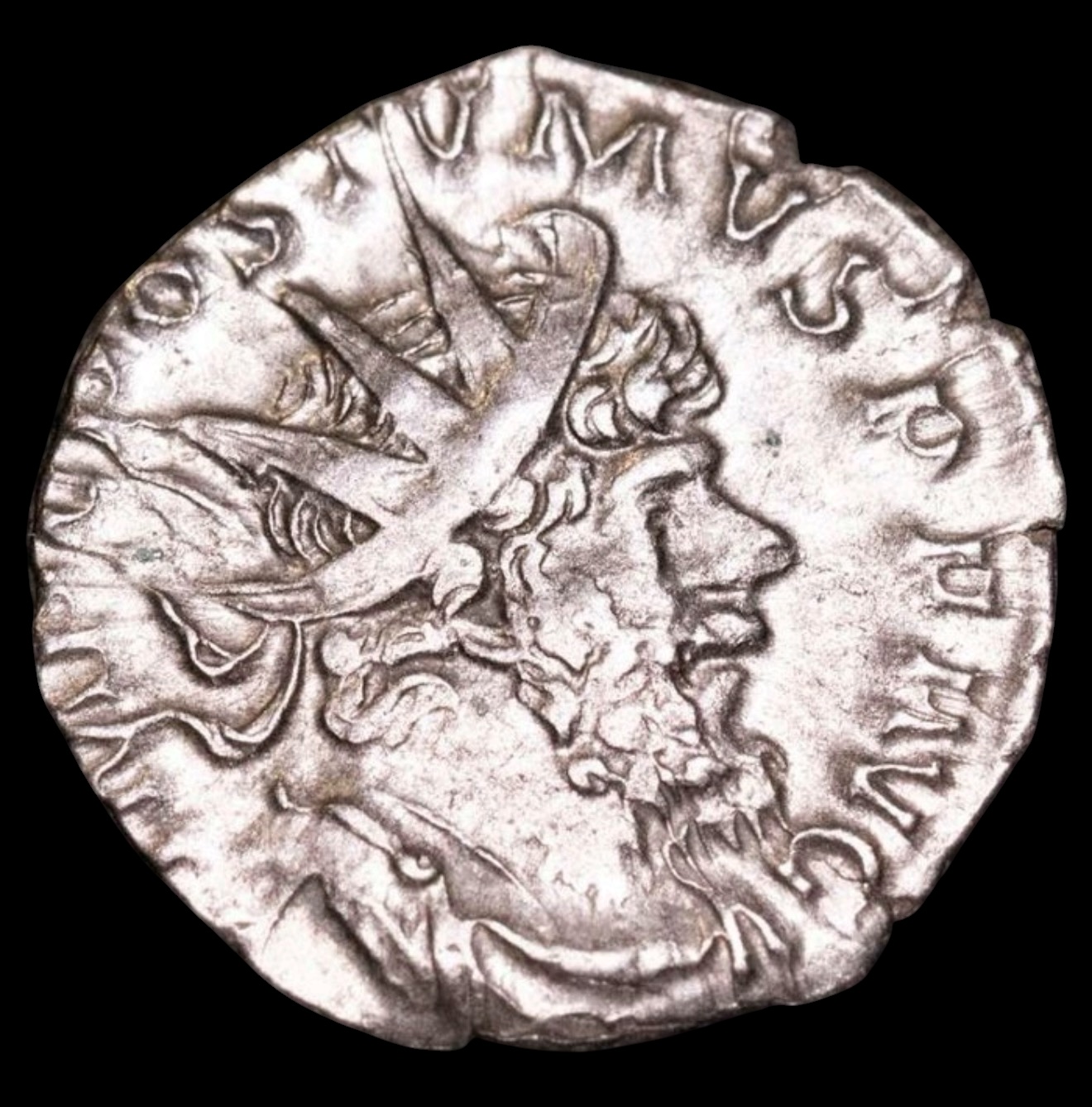
A silver Antoninianus struck under Postumus (260–269 AD), the first and most powerful ruler of the breakaway Gallic Empire. Minted at Treveri (modern-day Trier), this coin bears the obverse legend IMP C POSTVMVS P F AVG with a radiate, draped and cuirassed bust of Postumus facing right. The reverse depicts Felicitas standing left, holding a long caduceus and cornucopiae, with the legend FELICITAS AVG — 'The Good Fortune of the Emperor.' Postumus, a Gallic usurper of Batavian origin, established a rival empire spanning Gaul, Britannia and parts of Hispania, maintaining his own senate, consuls and mints at Cologne and Trier. His coinage is among the finest of the Crisis of the Third Century. This specimen — in near extremely fine condition (nEF) — displays excellent detail and a beautiful silver surface. Reference: RIC V 58 (Lugdunum).
Provenance & Details
- •Private collection, acquired prior to 1970.
- •from the Private Collection K. N. H., Switzerland
- •H.-J. Schulzki, Die Antoninianenprägung der gallischen Kaiser von Postumus bis Tetricus (AGK), 1996
- •G. Elmer, Die Münzprägung der gallischen Kaiser in Köln, Trier und Mailand, 1941
- •E. Besly & R. Bland, The Cunetio Treasure: Roman Coinage of the Third Century AD, 1983
- •R.A.G. Carson, P.V. Hill & J.P.C. Kent, Late Roman Bronze Coinage, 1960
- •British Museum, London (extensive Postumus antoniniani from the Cunetio and Normanby hoards)
- •Münzkabinett, Staatliche Museen zu Berlin (Roman Imperial and Gallic Empire collection)
- •Bibliothèque nationale de France, Paris — Cabinet des Médailles (Postumus holdings)
- •Rheinisches Landesmuseum Trier (local finds from the Treveri mint site)
- •Ashmolean Museum, Oxford (Coin Hoards of the Roman Empire project)
- •American Numismatic Society, New York (Roman Imperial collection)
FELICITAS AVG — DIVINE FORTUNE AND THE GALLIC EMPIRE
In the iconographic language of Roman coinage, few reverse types carry as much political weight as Felicitas — the personification of good fortune, prosperity, and divine favour. When the emperor Postumus (260–269 AD) chose the legend FELICITAS AVG for this antoninianus, he was making a deliberate statement: that the gods themselves had blessed his breakaway Gallic Empire with happiness and abundance. The figure of Felicitas, standing serenely with her caduceus (the herald's staff of Mercury, symbolising peace and commerce) and cornucopiae (the horn of plenty), embodied the promise of a prosperous and well-governed state. ¹
This silver antoninianus was struck at the mint of Treveri — modern-day Trier in Germany — one of the principal minting centres of the Gallic Empire. The question of mint attribution for Postumus's coinage has been one of the most debated topics in third-century numismatics. The Roman Imperial Coinage (RIC V.2) originally attributed this type to Lugdunum (Lyon), but modern scholarship, particularly the work of H.-J. Schulzki and G. Elmer, has demonstrated that the mint at Lugdunum was not reopened until Aurelian's reconquest in 274 AD. The coinage traditionally assigned to 'Lugdunum' was in fact produced at Treveri and Cologne, the two great administrative centres of the Gallic Empire. ²
Postumus himself — Marcus Cassianius Latinius Postumus — was one of the most remarkable figures of the Crisis of the Third Century. A military commander of Batavian or Gallic origin, he seized power in 260 AD following the catastrophic capture of Emperor Valerian by the Sasanian Persians. For nearly a decade, he governed an independent state encompassing Gaul, Britannia, and parts of Hispania, maintaining his own senate, consuls, and a coinage of extraordinary quality. His antoniniani are widely regarded as the finest coins produced during the entire crisis period, their careful engraving and relatively high silver content reflecting a regime that took its legitimacy — and its propaganda — very seriously. ³
The obverse bears the legend IMP C POSTVMVS P F AVG — Imperator Caesar Postumus Pius Felix Augustus — with a radiate, draped and cuirassed bust facing right. The radiate crown, a distinguishing feature of the antoninianus denomination, was introduced under Caracalla in 215 AD and became the standard marker for the double denarius. This specimen, weighing 3.46 grams and measuring 21 mm in diameter, is in near extremely fine condition (nEF), displaying exceptional detail in both the portrait and the reverse figure.
Comparable antoniniani of Postumus are held in the collections of the British Museum in London, which acquired extensive holdings from the Cunetio Treasure (54,951 coins found in Wiltshire in 1978) and the Normanby Hoard (approximately 47,000 coins discovered in Lincolnshire in 1985) — two of the largest third-century coin hoards ever found in Britain. ⁴ The Münzkabinett of the Staatliche Museen zu Berlin, the Cabinet des Médailles at the Bibliothèque nationale de France in Paris, and the Rheinisches Landesmuseum in Trier — located at the very site of the ancient mint — all hold significant collections of Postumus coinage. The Ashmolean Museum in Oxford maintains the Coin Hoards of the Roman Empire (CHRE) database, which catalogues thousands of Postumus specimens from hoards across the former empire. ⁵
Postumus was murdered by his own troops in 269 AD after refusing to let them sack the city of Mainz. His Gallic Empire survived him by five years before being reabsorbed by Aurelian in 274 AD. Yet his coinage endures as the most eloquent testimony to this extraordinary chapter of Roman history — a time when the western provinces, cut off from Rome, created their own functioning state and produced art of enduring beauty.
—
¹ C. H. V. Sutherland, Roman Coins (Barrie & Jenkins, London, 1974), pp. 212–218. ² H.-J. Schulzki, Die Antoninianenprägung der gallischen Kaiser von Postumus bis Tetricus (AGK): Typenkatalog der regulären und nachgeprägten Münzen (Bonn, 1996); G. Elmer, 'Die Münzprägung der gallischen Kaiser in Köln, Trier und Mailand,' Bonner Jahrbücher 146 (1941), pp. 1–96. ³ D. Woods, 'Postumus and the Solar Halo,' Numismatic Chronicle 172 (2012), pp. 85–100. ⁴ E. Besly & R. Bland, The Cunetio Treasure: Roman Coinage of the Third Century AD (British Museum, 1983); R. Bland & A. Burnett, The Normanby Hoard and Other Roman Coin Hoards (British Museum Press, 1988). ⁵ Coin Hoards of the Roman Empire (CHRE), Ashmolean Museum, University of Oxford: chre.ashmus.ox.ac.uk.
Enquire