Natural History
Precambrian Stromatolite Formation
Proterozoic Eon, ca. 1 Billion Years Old
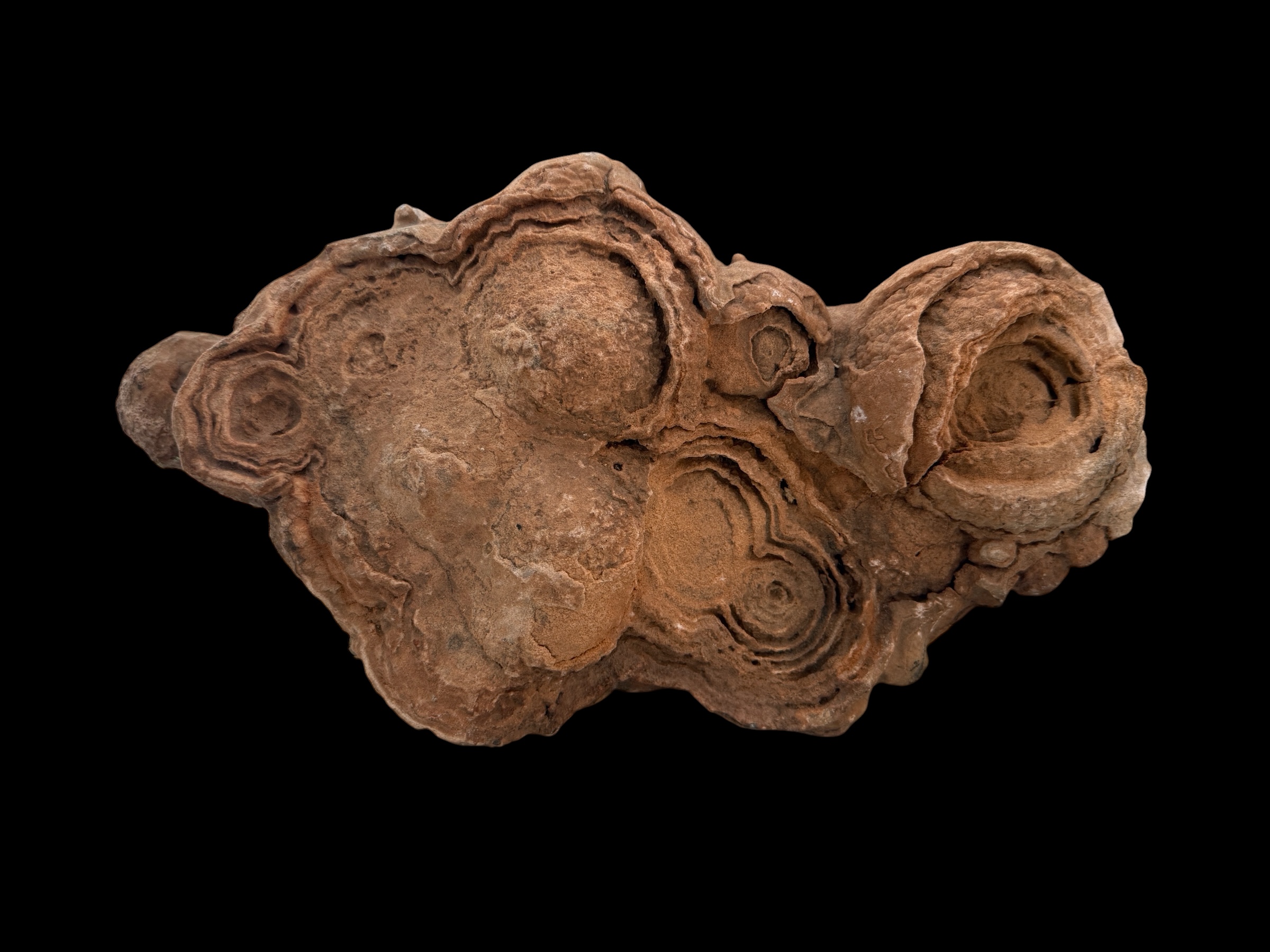
This extraordinary stromatolite formation represents one of the most profound witnesses to life on Earth — a billion-year-old monument to the earliest organisms that fundamentally transformed our planet. Formed by colonies of cyanobacteria during the Proterozoic Eon, this specimen preserves the layered biosedimentary structures created by photosynthetic microbes that were among the first life forms to harness the energy of sunlight.
The concentric laminations visible across the surface of this large formation — each ring representing countless generations of microbial mats — tell the story of life’s patient conquest of a young and hostile world. These ancient cyanobacteria were the architects of Earth’s atmosphere: through photosynthesis, they produced the oxygen that would eventually make complex life possible. The Great Oxidation Event, approximately 2.4 billion years ago, was driven by organisms identical to those that built this very structure.
At approximately one billion years old, this specimen dates to the Mesoproterozoic Era, a period when stromatolites dominated the shallow seas of the ancient world. Their dome-shaped and columnar forms created vast reef systems visible from space — the first true ecosystems on Earth. The multiple dome structures preserved in this formation, with their characteristic concentric growth patterns, demonstrate the colonial nature of these organisms and their remarkable ability to trap and bind sediment layer upon layer over geological timescales.
The warm ochre and sienna tones of the mineralised layers, interspersed with bands of blue-grey chert, reveal the complex geochemistry of ancient shallow marine environments. Each lamina represents a cycle of growth, sediment trapping, and mineral precipitation — a rhythm repeated billions of times over the formation’s existence.
This is not merely a fossil in the conventional sense. It is the physical record of life’s most consequential innovation: photosynthesis. Without stromatolite-building organisms, there would be no breathable atmosphere, no ozone layer, no complex life. Every breath we take is owed to creatures like those that built this formation a billion years ago.
As a large and exceptionally well-preserved specimen with multiple clearly defined dome structures, this stromatolite formation is a masterpiece of deep time — a tangible connection to the very origins of life on Earth.
Provenance & Details
- •Riding, R., Microbial Carbonates: The Geological Record of Calcified Bacterial-Algal Mats and Biofilms, Sedimentology, 2000
- •Grotzinger, J.P. & Knoll, A.H., Stromatolites in Precambrian Carbonates: Evolutionary Mileposts or Environmental Dipsticks?, Annual Review of Earth and Planetary Sciences, 1999
- •Awramik, S.M., The Oldest Records of Photosynthesis, Photosynthesis Research, 1992
Enquire