Coins
Roman Battle Scene
Roman Empire
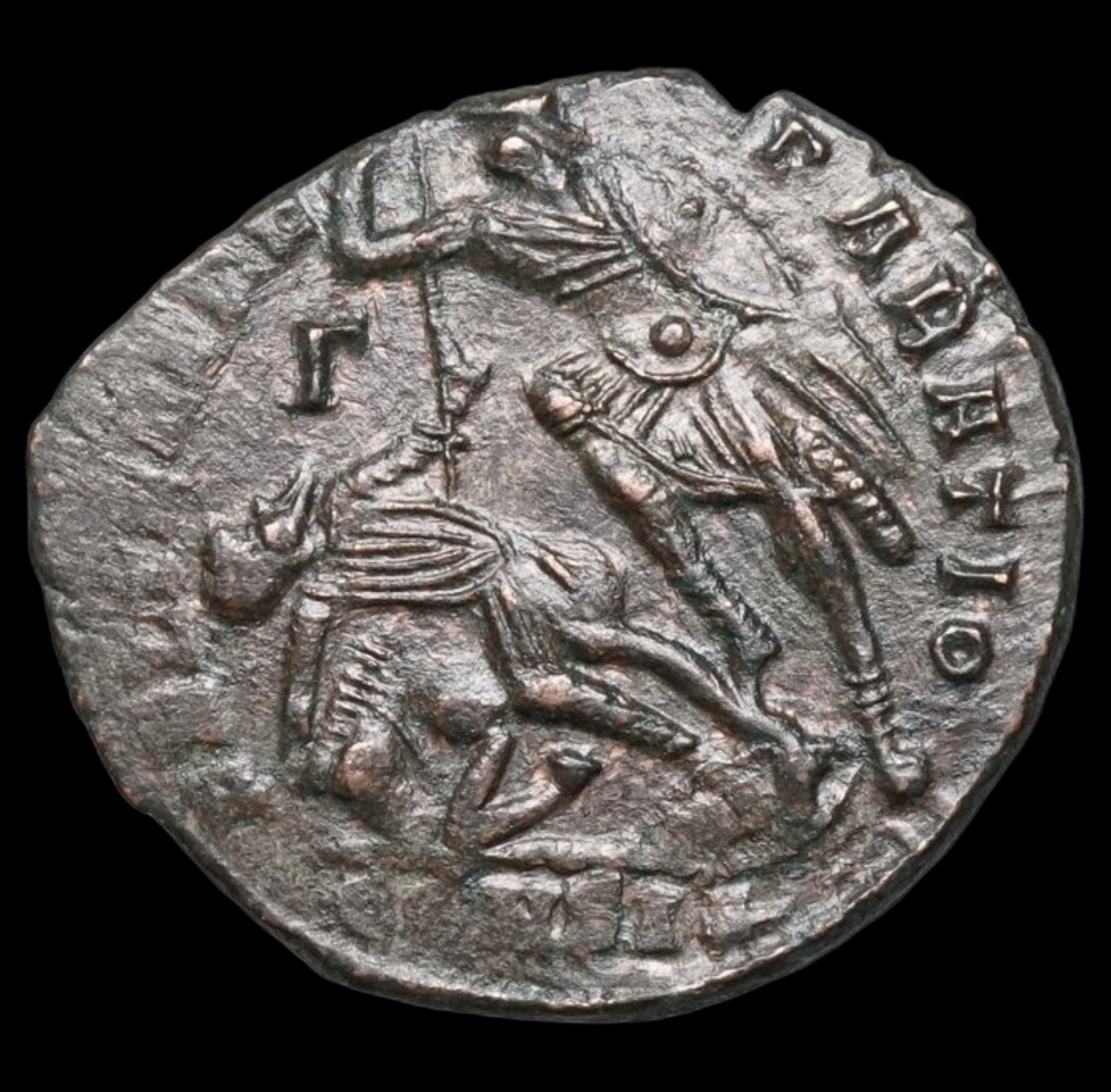
War was the engine of Rome. The legions — disciplined, relentless, and technologically superior — conquered the known world and held it for centuries. This coin, depicting a battle scene on its reverse, celebrates the martial prowess that was the foundation of Roman identity and the source of Roman power.
Battle scenes on Roman coins served a dual purpose: they commemorated specific military victories and they projected an image of invincible strength to every corner of the empire. A farmer in Gaul, a merchant in Syria, a fisherman in Britain — all would see this coin and be reminded that the might of Rome was absolute and its legions unconquerable.
The artistry of this battle scene — the dynamic composition, the sense of movement and violence, the careful rendering of armour and weapons — speaks of a civilisation that elevated warfare to an art form. For the Romans, military glory was the highest virtue, and coins like this were its most democratic expression.
Provenance & Details
- •Private collection, acquired prior to 1970.
- •from the Private Collection K. N. H., Switzerland
- •Malone, C.W., Violence on Roman imperial coinage, Journal of the Numismatic Association of Australia, 2009
- •Burnett, A.M., The iconography of Roman coin types in the third century BC, The Numismatic Chronicle, 1986
- •Gilliver, K., Display in Roman warfare: the appearance of armies and individuals on the battlefield, War in History, 2007
- •Rowan, C., Theoretical approaches to Roman imagery and iconography, The Oxford Handbook of Roman Imagery and Iconography, 2021
- •Kemmers, F., Coin iconography and social practice in the Roman Empire, The Oxford Handbook of Roman Imagery and Iconography, 2021
In the Roman Empire, coins were far more than simple currency; they were a sophisticated medium for mass communication, circulating imperial ideology to the furthest corners of its vast territory. Before the widespread use of coinage, which began to be adopted in the 4th century BCE, wealth was often measured in livestock. The transition to metal currency, however, offered emperors a unique opportunity. Each coin became a miniature monument, a carrier of state-approved messages that could reach every citizen and soldier, reinforcing the power and stability of the regime with every transaction.
Military victories were a cornerstone of imperial propaganda on coinage. Depictions of battle scenes, vanquished enemies, or triumphal processions were not merely commemorative; they were a deliberate strategy to project the emperor's authority as a supreme military commander. When Julius Caesar became the first living Roman to place his own portrait on a coin, he set a powerful precedent. His successor, Augustus (27 BCE – 14 CE), perfected this art, consistently presenting an idealized, youthful image to signify enduring strength and stable leadership. These coins served as a daily reminder to the populace of Rome's military might and the emperor's role as the ultimate guarantor of peace and security, a concept known as the Pax Romana.
Today, these ancient coins are invaluable historical documents. They provide a direct glimpse into the political narratives the Roman state sought to promote, offering insights into the values, priorities, and anxieties of the time. Each piece, bearing the image of an emperor or a scene of conquest, tells a story of power and persuasion. They are tangible relics of a world where currency was a potent tool for shaping public opinion, demonstrating that the art of political messaging is as ancient as civilization itself.
Enquire