Antiquities
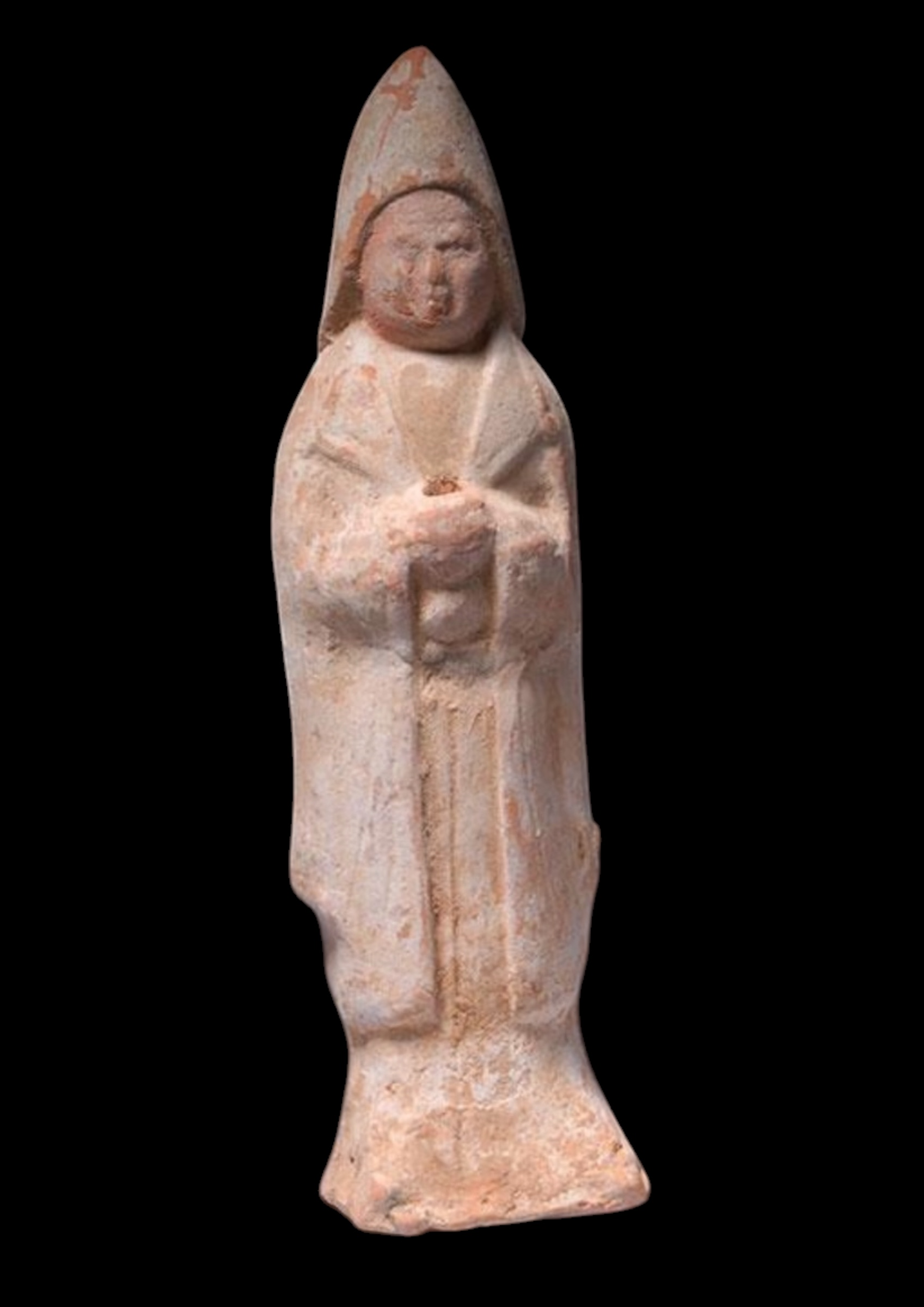
Tang Dynasty Terracotta Official
Tang Dynasty, ca. 900 AD, Oxford TL-Tested
A Chinese terracotta figure of a standing official or attendant, dating to the late Tang Dynasty, circa 900 AD. The figure is mould-made and depicts a male personage wearing a long, flowing robe with a thick over-cloak open at the chest, and a tall conical cap — a form of headgear frequently associated with non-Chinese individuals from Central Asia or the northern frontier regions of the Tang Empire. The hands are held close to the chest with a perforation between them, indicating that the figure once held a thin implement, perhaps a taper or candle intended to light the darkness of the tomb.
Standing 18.4 cm in height, the figure is rendered in a pale buff-coloured earthenware with traces of the original cold-applied pigments still visible on the surface — remnants of red and white that once enlivened the garments and facial features. The heavy layered clothing suggests a figure dressed for a cold climate, consistent with the identification as a foreigner or border official from the northern or western reaches of the empire, where Central Asian dress traditions persisted well into the late Tang period.
The figure has been authenticated by Oxford Authentication Ltd. through thermoluminescence analysis (Sample No. C112g17, dated 5 July 2012, by Doreen Stoneham), which confirmed that the ceramic was last fired between 900 and 1500 years before the date of testing — fully consistent with a late Tang Dynasty attribution. The piece was acquired in London in the 1980s from a group of similar figures that had entered the London trade from a private collection.
Provenance & Details
- •Acquired 1980s, London art market (from a group of similar figures)
- •from the Private Collection K. N. H., Switzerland
- •E. Schloss, Ancient Chinese Ceramic Sculpture from Han through T'ang, 2 vols., Castle Publishing, Stamford, 1977
- •J.G. Mahler, The Westerners Among the Figurines of the T'ang Dynasty of China, Serie Orientale Roma XX, IsMEO, Rome, 1959
- •J. Rawson, The British Museum Book of Chinese Art, British Museum Press, London, 1992
- •S.G. Vainker, Chinese Pottery and Porcelain: From Prehistory to the Present, British Museum Press, London, 1991
- •Metropolitan Museum of Art, New York (acc. 23.95.2 — earthenware civil official with pigment, Tang Dynasty, 7th–8th century, H. 92.7 cm)
- •Metropolitan Museum of Art, New York (acc. 11.83.2 — civil official with sancai glaze, late 7th–first half 8th century, H. 83.8 cm)
- •British Museum, London (1936,1012.221 — sancai civil servant from tomb of General Liu Tingxun, d. 728 AD, H. 107 cm, Luoyang)
- •Smithsonian Institution, Washington D.C. (RLS1997.48.1449 — head of Sogdian/Central Asian traveler with cone-shaped hat, Tang Dynasty, ca. 700–750)
The present terracotta figure belongs to a well-established category of Chinese funerary sculpture known as mingqi (明器) — "spirit objects" placed in tombs to serve the deceased in the afterlife. This tradition, rooted in beliefs dating back to at least the Shang Dynasty (ca. 1600–1046 B.C.), reached its artistic zenith during the Tang Dynasty (618–906 AD), when the production of ceramic tomb figures became an elaborate and highly codified practice governed by sumptuary regulations that prescribed the number and type of figures permitted according to the rank of the deceased.¹
The figure depicts a standing male personage wearing a long, flowing robe with a thick over-cloak open at the chest and a tall conical cap. This distinctive headgear is of particular interest: rather than the standard futou (幞头) or wushamao (乌纱帽) worn by Chinese court officials, the pointed cap closely resembles the felt or leather headgear associated with peoples from Central Asia, the Sogdian trading communities, and the northern frontier regions of the Tang Empire. The Metropolitan Museum of Art holds a comparable pair of civil officials (acc. 11.83.2) described as figures that "undoubtedly depict foreigners of Western origin" yet are "dressed in the typical Tang-dynasty Chinese court dress."² This fusion of foreign physiognomy with Chinese official attire reflects the remarkable cosmopolitanism of Tang China, where Sogdian merchants, Persian traders, and Central Asian envoys were a familiar presence in the great cities of Chang'an and Luoyang.
The hands are held close to the chest with a perforation between them, indicating that the figure once held a thin implement — perhaps a taper or candle intended to illuminate the darkness of the tomb chamber. This functional detail is well attested among Tang mingqi: attendant figures were frequently equipped with objects appropriate to their role, whether musical instruments, weapons, or implements of service.³
Standing 18.4 cm in height, the figure is rendered in a pale buff-coloured earthenware characteristic of late Tang production. Traces of the original cold-applied pigments — remnants of red and white — remain visible on the surface, evidence of the polychrome decoration that once enlivened the garments and facial features. The heavy, layered clothing suggests a figure dressed for a cold climate, consistent with the identification as a foreigner or border official from the northern or western reaches of the empire.
The figure has been authenticated by Oxford Authentication Ltd. through thermoluminescence (TL) analysis, the internationally recognised scientific method for dating fired ceramics. The test (Sample No. C112g17, dated 5 July 2012, conducted by Doreen Stoneham) confirmed that the ceramic was last fired between 900 and 1500 years before the date of testing — a result fully consistent with a late Tang Dynasty attribution, circa 900 AD.⁴
Comparable figures of significantly larger scale are held in major international collections. The British Museum possesses a sancai-glazed civil servant (1936,1012.221, H. 107 cm) from the celebrated tomb of General Liu Tingxun (d. 728 AD) at Luoyang — a figure that formed part of the renowned Eumorfopoulos Collection and has been published extensively, including in MacGregor's A History of the World in 100 Objects (2010).⁵ The Smithsonian Institution holds the head of a Sogdian or Central Asian traveler (RLS1997.48.1449) wearing an almost identical cone-shaped hat, described as representing a figure from the Iranian-speaking Sogdian communities who dominated Silk Road commerce during the Tang period.⁶
¹ For the sumptuary regulations governing Tang Dynasty tomb furnishings, see J. Rawson, The British Museum Book of Chinese Art, British Museum Press, London, 1992, pp. 196–202. ² Metropolitan Museum of Art, New York, acc. 11.83.2; see also acc. 23.95.2 (H. 92.7 cm), Gift of Mrs. Edward S. Harkness, 1923. ³ E. Schloss, Ancient Chinese Ceramic Sculpture from Han through T'ang, 2 vols., Castle Publishing, Stamford, 1977, vol. II, plates 180–220. ⁴ Oxford Authentication Ltd., TL Test Report, Sample No. C112g17, 5 July 2012, by Doreen Stoneham. ⁵ British Museum, London, 1936,1012.221; see R.L. Hobson, "The Eumorfopoulos Collection: T'ang Pottery Figures in the Victoria and Albert Museum", The Burlington Magazine, January 1921; N. MacGregor, A History of the World in 100 Objects, London, 2010, No. 55. ⁶ Smithsonian Institution, Washington D.C., RLS1997.48.1449; for the role of Sogdian merchants in Tang China, see J.G. Mahler, The Westerners Among the Figurines of the T'ang Dynasty of China, Serie Orientale Roma XX, IsMEO, Rome, 1959.
Enquire