Stamps
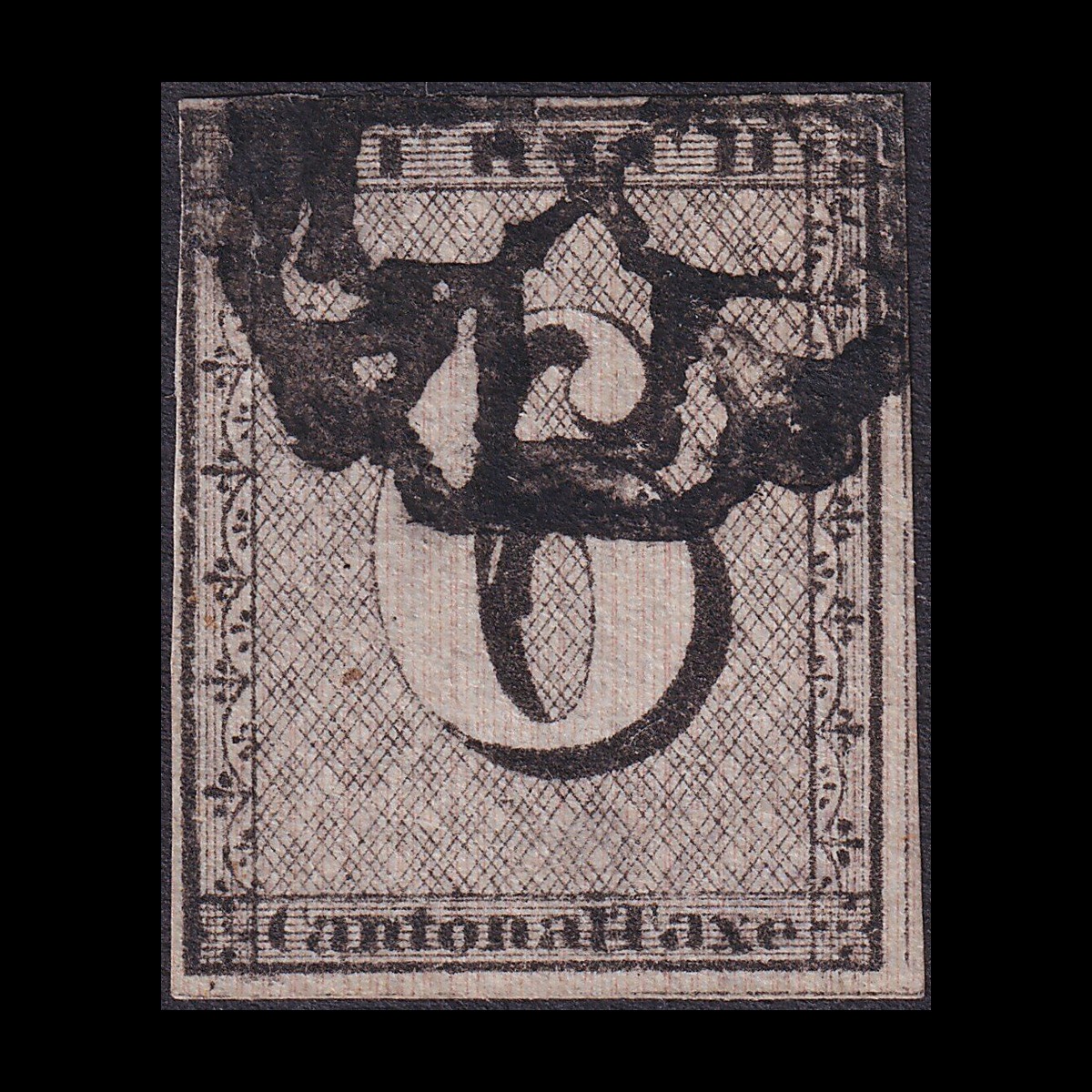
Zürich 6 Rappen — Cantonal-Taxe
SBK 2S, Type I, Position 41, black rosette, APEX certified
A definitive monument of philatelic history, the Zürich 6 Rappen of 1843 is an object of immense cultural and historical significance. It holds the extraordinary distinction of being the first postage stamp issued on the European continent, and the third government-issued adhesive stamp in world history, following only Great Britain’s iconic Penny Black and Two Pence Blue of 1840. This example, a beautifully preserved specimen cancelled with the characteristic black rosette, is not merely a stamp but a tangible link to a pivotal moment in the history of communication, a time when the world was rapidly shrinking and the foundations of modern logistics were being laid. Its issuance by the Canton of Zürich, a sovereign republic at the time, predates the formation of the Swiss Confederation and its unified federal postal system, making it a relic of a bygone political era and a testament to Zürich’s role as a pioneer in governance and commerce.
The design of the Zürich 6 Rappen, created by the renowned lithographer Orell Füssli, is a masterpiece of early 19th-century graphic art, embodying a striking and functional modernism that was decades ahead of its time. The composition is dominated by a bold, clear numeral '6', indicating its value, set against a background of intricate red vertical lines. This simple, powerful design was a deliberate choice, intended for immediate legibility and to prevent forgery. The inscriptions 'ZÜRICH' at the top and 'CANTONAL-TAXE' at the bottom frame the central numeral, clearly delineating its origin and intended use. The 6 Rappen denomination was specifically for letters mailed to any destination within the canton, a higher rate than the 4 Rappen stamp which served local mail within the city of Zürich itself. This dual-rate system was a sophisticated innovation, reflecting the complex postal needs of a thriving commercial state. The fine craftsmanship of the lithography, with its crisp lines and balanced composition, elevates the stamp from a mere piece of fiscal paper to a miniature work of art.
This particular specimen is further distinguished by its specific plating characteristics, identified as Type I, Position 41 from the original printing sheet of 100. Philatelic scholarship has painstakingly reconstructed the original sheets, noting the subtle variations and flaws that occurred during the lithographic process for each of the 100 positions. The ability to plate a stamp to its exact position on the sheet is the mark of a truly sophisticated collection and adds a profound layer of historical and academic value. This stamp was once part of a larger whole, a single square in a grid of one hundred, each with its own unique identity. Its journey from the printing press of Orell Füssli in 1843, to a letter traversing the canton of Zürich, to its survival through nearly two centuries of history, is a remarkable saga of preservation. The black rosette cancellation, neatly struck, is the final touch of authenticity, a silent witness to the moment the stamp fulfilled its postal duty.
Provenance and certification are paramount in the world of high philately, and this Zürich 6 Rappen is accompanied by an ironclad pedigree. It has been examined and certified as genuine by the American Philatelic Expertizing Service (APEX), one of the world's most respected authorities. The APEX certificate, No. 167159, issued on February 28, 2006, and signed by the esteemed philatelist Robert E. Lamb, confirms its identity as SBK Nr. 2S, Type I, Position 41. While the certificate notes a minor crease in the upper-right corner, this is a common trait for used stamps of this age and does not detract from its immense rarity and visual appeal. In the world of 19th-century philately, such minor imperfections are often seen as part of the object's unique history. This stamp’s journey is documented, its authenticity is beyond question, and its place in the pantheon of philatelic treasures is secure.
To hold the Zürich 6 Rappen is to hold a piece of the dawn of global communication. It represents a revolutionary idea: that postage could be prepaid with a simple, adhesive label, an innovation that democratized correspondence and fueled the growth of commerce, education, and personal connection. It is a symbol of Swiss ingenuity and precision, a forerunner to the country's later reputation for excellence in engineering and design. For the discerning collector, this stamp is more than an acquisition; it is the custodianship of a pivotal artifact of Western civilization. It is a story of cantonal pride, technological advancement, and the enduring power of the written word, encapsulated in a small, unassuming piece of paper that changed the world.
Provenance & Details
THE FIRST STAMPS OF CONTINENTAL EUROPE: THE ZÜRICH CANTONAL ISSUES
On 1 March 1843, the Canton of Zürich made postal history by issuing the first adhesive postage stamps on the European continent. The Zürich 4 and 6 Rappen stamps — known to collectors as the "Zürcher Nummern" (Zurich Numerals) — were preceded only by Great Britain's Penny Black (1840) and the Mulready stationery, making them among the earliest stamps in the world.
The stamps were designed and printed by the renowned Zurich printing house Orell Füssli, which had been established in 1519 and remains in operation today. The design is remarkably modern: a bold numeral dominates the centre, set against a finely cross-hatched background that served as a security feature against counterfeiting. The inscription "ZÜRICH" appears above and "Cantonal-Taxe" below, clearly identifying the issuing authority and the nature of the charge.
The 6 Rappen denomination was used for letters carried within the entire canton, while the 4 Rappen served local city mail within Zürich itself. The stamps were printed in sheets of 100, and each position in the sheet exhibits subtle variations in the cross-hatching and lettering — making positional identification a fascinating area of specialist study. The Type I designation indicates the first state of the printing stone, while Position 41 places this stamp precisely within the original sheet.
The black rosette cancellation (schwarze Rosette) used on this example is characteristic of early Swiss postal practice. The American Philatelic Expertizing Service (APEX), established in 1903, provides internationally recognized authentication for stamps of this calibre. Their certificate confirms not only the genuineness of the stamp but also its precise typological and positional classification — scholarship that elevates this small piece of paper from a mere postal artifact to a precisely documented monument of European communication history.
Enquire